Ritxi Ostáriz - The symbol, universal stories, Jung, the hero's journey | B4F #40
Category
News
Date
Duration
2 minutes

In this new episode of Brands 4 Future we speak with Ritxi Ostáriz, designer and lecturer, director and host of El Libro Rojo, a podcast with more than 250 episodes exploring anthropology and psychology.
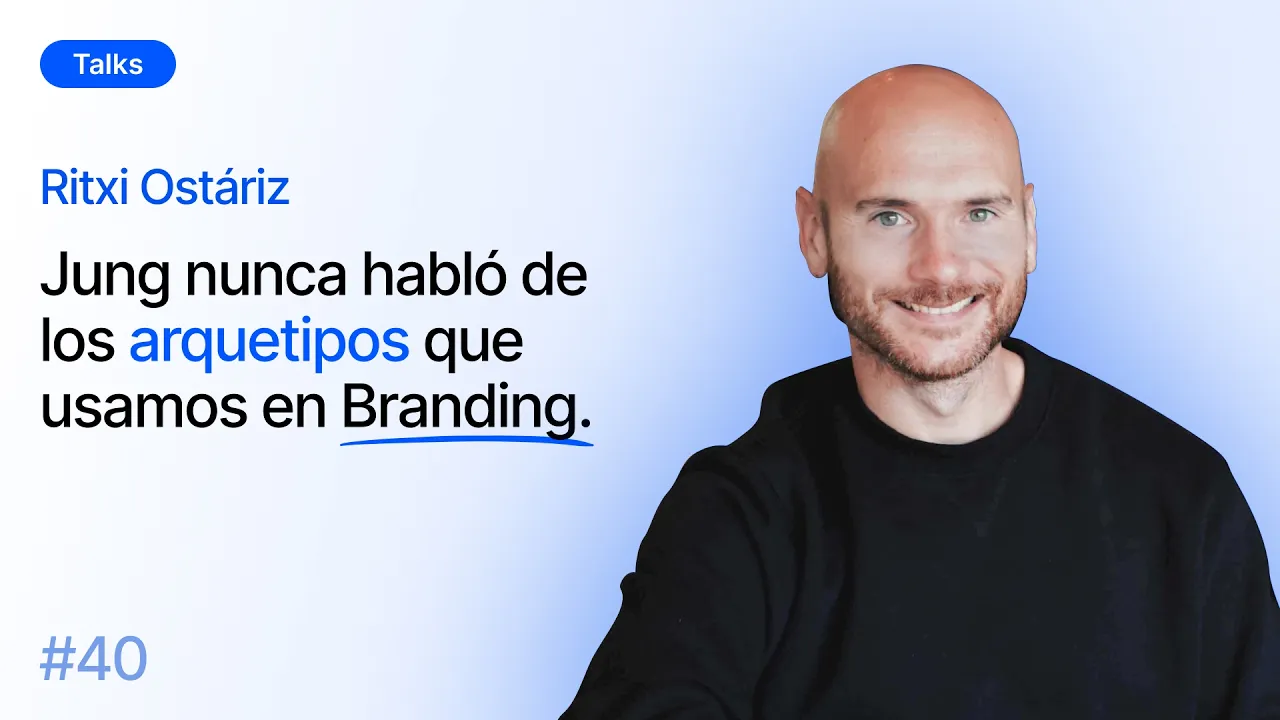
We chat about the philosophy, anthropology, and psychology underpinning every form of communication: the symbol, Jung’s unconscious, archetypes, and those universal structures present across narratives in most cultures around the world. We also discuss Joseph Campbell and the hero’s journey, cultural identity and religion, and his experience living in Chile.
Ritxi Ostáriz: https://ritxiostariz.com · El Libro Rojo: available on Spotify (@ellibrorojor)
Full episode transcript
Introduction
Episode teaser: Ritxi Ostáriz: The definition of a symbol… we could turn to philosophy, to anthropology, there are plenty. But ultimately they always share one thing in common: a surface layer that I can see, which has a layer behind it that is its meaning. And as for the symbol, if nobody tells me what it means, I cannot possibly know.
Episode teaser: Guille: Is it Jung's collective unconscious that constructs the monomyth? Since there is a monomyth that has spread everywhere, do archetypes repeat themselves, or does this collective unconscious repeat itself?
Episode teaser: Ritxi Ostáriz: There was another author, George MacDonald, who was a great fairy tale specialist; in fact, he was a major inspiration for Tolkien. He said something very lovely: in fairy tales, the laws of physics may vary, but ethical and moral laws do not. Those are the archetypes. Joseph Campbell gathers all these narratives from human history across their different formats, and by studying them he finds a common pattern. You take Saint John of the Cross and he isn't very different from a Sufi mystic or from Buddhist thought. Religion is merely one part of a people's cultural identity, whereas each culture's identity is truly, for me, the brand.
Guille: Welcome to a new episode of Brands 4 Future. In today's episode, we speak with Ritxi. Ritxi is genuinely passionate about the anthropology of belief, history, philosophy, and psychology. He hosts a podcast, El Libro Rojo, where for many years they have delved deep into all these topics; as he puts it, a return to the sources of the sacred. And in this conversation, we talked about precisely all of this: myth, symbol, archetypes, Carl Gustav Jung, and Joseph Campbell. I hope you enjoy this conversation as much as I did. Let's get straight into it. Well, Ritxi Ostáriz, welcome to our podcast. How are you doing?
Ritxi Ostáriz: Glad to be here, as the guests on my podcast often say—we'll get to that later. Usually, I'm the one asking the questions, so this is quite an anomalous situation for me, but I'm very grateful to be here.
Guille: How does it feel being on the other side of the interview or conversation?
Ritxi Ostáriz: More nerve-racking, I suppose. I think I've grown accustomed to steering the conversation myself, or leading classes with my students. At the end of the day, I'm usually the one on this side of things.
Guille: And you're currently in Chile; you only arrived recently.
Ritxi Ostáriz: I'm in Santiago de Chile, indeed. I've been here for a month now. This is my fourth time visiting Chile. I'm working here at the university this semester, so yes, we're dealing with a bit of a time difference, though not dramatic yet. Soon, when the clocks change (over there for summer time and here for winter time), it really will become an insurmountable gap. Just this weekend over there; here, I think it's a bit later.
Guille: And, if you'd like, tell us a bit about that, because Chile is an important country for you, both professionally and personally.
Living in Chile
Ritxi Ostáriz: We'd have to step back a bit. 2022 was the first time I came to Chile to teach at university. I didn't know the country; I knew nothing beyond what people had told me about its wonderful natural landscape. So I thought: well, I'll go and discover it. We're talking about 2022, post-pandemic, when borders were starting to reopen and people could travel again. I'm very much a traveller, a mountain person, semi-nomadic, as I often define myself. Through past experiences, I met people here from the Universidad del Desarrollo, in Santiago de Chile, and told them: "Look, I'm heading over to Chile with a rucksack; if you'd like, I could give a lecture, a masterclass, a workshop for your students, whatever works." And they said: "Well, look, if you want to come for 4 months, come for the whole semester and we'll create an opening for you as a visiting lecturer," as they call it here. And off I went. It was an incredible experience. Every single weekend, I took the opportunity to get away and explore what is a fascinating country. Having travelled extensively around the world, I always say there is no nature quite like Chile's. For other things, I might rank another country at number one, but for nature, nowhere matches Chile. I fell in love with that experience, and this is already my fourth time here. I'm already quite Chileanised in many ways, learning a great deal about their culture, their distinctive way of speaking, of using Spanish. I have many friends here now; it's not like the first time you arrive. I'm quite well integrated. And out of one of those stays came a book called "Volcanes y araucarias" (Volcanoes and Monkey Puzzle Trees).
Guille: "Volcanoes and Monkey Puzzle Trees".
Ritxi Ostáriz: That was the first trip, my travel journal. What happened with the book was interesting, because for a few years I had wanted to write a book; after consuming so many books, I felt I ought to write one, but I never knew what about. Do I write about anthropology, about philosophy—which are my passions—about nature, about design? I could never make up my mind. On that journey, I began jotting down notes on my phone, almost from my very first internal trip around the country, when I went to explore places outside Santiago, which was San Pedro de Atacama, and posting them on Instagram. It started off like that, like "dear travel diary, I know I've never written to you before and perhaps I never will again," thinking it was just a sort of blog post I'd do that day; and that turned into every single day. Sometimes I was in mountains, forests, rivers; other times I was relaxing in bed, lying down in Santiago, taking a break from the city's pace. It became a journal, as I like to put it, that was deeply external and internal. I recounted what I saw with my own eyes, but also how I felt: internal processes, fascinating moments, peak moments, key turning points—hinge moments, as some people call them—that alter the course of your life. And in the end, when I returned to Spain, I realised I had 200 or 300 pages of a book already written. Being a lover of books—not just reading them, but making and designing them—I took the plunge, and about a month ago, every single copy I printed of "Volcanes y araucarias" sold out.
Guille: And do you think that book would have emerged anywhere other than in Chile's wild landscapes?
Ritxi Ostáriz: Probably, yes. The thing is, that first time in 2022, despite all my travels around the world, was genuinely the first time I had ever gone to live abroad. I never had experiences like Erasmus or exchanges as a child; I didn't have them because I never wanted them. I always wanted to go on holiday to my village in Burgos; I never had the ambition or desire to travel the world. That was the first time I spent an extended period abroad, and perhaps that made me approach it differently. Had I been in Indonesia or Norway, it might have come about as well. What I don't think is that it would have taken the shape it did. I fell in love with Chile. Beyond Mount Teide, I'd had no experiences with volcanoes, and I had never seen an araucaria—a monkey puzzle tree—which many listeners might not be familiar with. It's a tree, but to me it isn't just a tree: they are living beings so fascinating that, whenever I stand in an araucaria forest, I always get the feeling that, if all the trees on planet Earth are human beings (let's use this analogy), araucarias are angels; they are like divinised trees, celestial trees. They're something else entirely. I fell in love, hence the title of the book. It came about that way, from that blend: Chile's nature holds an ancient essence. I wrote about it on social media the other day: ancestry and vastness. I come from a country like Spain, which is fascinating and wonderful, whether you traverse it north to south, east to west, but where you don't feel true remoteness. Part of me is from Burgos, bordering Soria, what we call that emptied Spain, that Spanish Siberia or Lapland, almost. Yet when you find yourself in a place like this, you realise what remote truly means; for us, a 2-hour journey can feel long, whereas here, 2 hours is like popping around the corner for a loaf of bread. And you arrive at places that make you think: prehistoric. Just this past weekend I was in Conguillío National Park (which is why my voice is a little croaky), in the Andes, camping at 0 degrees, and you're standing there thinking: the sheer vastness and remoteness. Naturally, I'm certain there are places in the world that are just as beautiful. I always mention it: I've visited Switzerland, I've visited Norway, and I imagine Canada or New Zealand are on par with Chile in this respect. But Chile has something unique: amidst that nature, suddenly you have a 4,000 or 5,000-metre volcano billowing smoke, and you think: "Right, I don't get that in Switzerland or Norway."
Guille: Yes, that's the differentiator. And it's just as you say, what those of us who love mountains share: seeking the solitude of these lonely landscapes, seeking the vastness, these snow-capped peaks or deserts, these atypical landscapes. Or the forests, too.
Ritxi Ostáriz: Spot on. What's more, Chile, as I think is widely known, is exceptionally long and narrow. So you have every kind of landscape: from Atacama, from the north, from the altiplano, which borders Bolivia and Peru (I think most people have roughly seen the Uyuni salt flats in Bolivia on Instagram, that sort of stark, high-altitude, bitterly cold scenery). Heading south, you find forests, you find the central mountain range, which sits midway, but continuing south you reach the ice fields, which are hundreds upon hundreds of kilometres of sheer glacier. In fact, many parts of that territory remain unexplored, and that's one of the things that astounds me: you can view the world we live in from above with Google Maps, yet there are still places you simply cannot reach. Once you leave the ice fields, you still have Tierra del Fuego, Punta Arenas, that famous Torres del Paine park; keep going south and you're practically at Antarctica. You have everything within a single country, and, as you were saying, all of it remote, immense, prehistoric. I remember when I arrived at Conguillío Park: suddenly you reach a viewpoint and there's that lake, that volcano, and you almost expect pterodactyls to fly overhead.
Guille: That's the only thing missing. It feels like another planet or another era.
Ritxi Ostáriz: It's still our planet, but another era. Indeed, a pre-human era. There are still landscapes just like the ones Shackleton and Amundsen and those great explorers saw. That's the feeling I get here. That's what I meant: in Spain we have wonderful places, incredible national parks, but human contact is evident at every turn. You will always see a little cottage, or an electricity cable in the distance, or a path, a road, or fellow hikers on the trail. But here, you don't. What you've just said is constantly on my mind. I say it to the people I travel with: what on earth must it have been like crossing the Andes for the very first time, when there wasn't a single map, when there wasn't a single path, when you didn't know if heading down a valley meant having to retrace everything you'd covered over the past month, in extreme conditions? That sheer vastness, with no possibility of rescue, no way of calling for help whatsoever, and with pumas roaming around.
Guille: Of course. But beyond Chile, it's clear you exude passion for this country; it has thoroughly captivated you. You're from Bilbao, aren't you?
Ritxi Ostáriz: I'm from Bilbao.
Personal and professional background
Guille: Were you raised in Bilbao or in Burgos?
Ritxi Ostáriz: I'm half and half. I'm half from Bilbao, on my father's side; I was born in Bilbao and spent the first years of my life there, and I'm a huge Athletic Club fan: that part stays with me until the day I die. But at age 9, we moved to Madrid. My youth and adolescence were spent mostly in Madrid, until I was finally able to get away from there, running, fleeing. But Burgos has always been my mother's side, and what we in Spain would traditionally call "my village": my friends, all my people to this day are in Burgos, in Salas de los Infantes.
Guille: You talk a lot about Burgos, about your younger years there.
Ritxi Ostáriz: Yes, that Castile is the one that still endures. Truly, Bilbao right now… there's family, the odd distant friend, but I don't set foot there very often. My mind travels to Bilbao every weekend for the Athletic matches, but I don't have much other contact because my parents aren't there anymore either. It's always Burgos, that village in Burgos, Salas de los Infantes, my base camp. It's where I always go whenever I need to return. That's where I keep my boxes of books and, right now, my camper van waiting for me, and little else, because I don't own more possessions nor do I want them. That's where I experienced my first loves, my first drunken nights, my first parties with friends, and I still always go back. It's also very mountainous country, because we're used to thinking of Burgos as the flat Castilian plain, but the part of Burgos in my blood borders Soria, the Sierra de la Demanda: we're talking about the Picos de Urbión, the Neila lagoons, verdant, lush green territories, pine country. Perhaps that setting instilled in me this love of nature and the mountains. Here in Chile, for instance, pine trees are frowned upon because they are an introduced, non-native, invasive species, but for me, whenever I visit a place with pines, I feel right at home. It's part of our landscape, like the holm oak, which is part of the identity of Castile as a whole: holm oak, oak, beech, juniper. There, in the Arlanza valley, where names like Santo Domingo de Silos or Covarrubias might ring a bell, lies the area surrounding my village.
Guille: And we haven't touched on your professional background. I don't like defining people solely by what they do professionally, but we should mention that you've devoted a long time to design, branding, lecturing—which we touched upon—and podcasting. Those would be the four cornerstones of your professional life.
Ritxi Ostáriz: With one qualification: the podcast isn't professional, because I don't earn a single penny from it. That is purely for the love of the craft, purely a hobby, pure passion, which we'll discuss shortly. But yes, professionally I'm still a designer; I remain one. It's true that over the past 9 years I've increasingly focused on the student rather than the client. Nowadays I thoroughly enjoy my profession, which is lecturing at university: that's what I'm doing in Chile and what I also do in Spain, at IE,
Ritxi Ostáriz: … both in Madrid and Segovia, at the School of Architecture and Design. And I've gradually stripped away the more… I don't like sitting in front of a computer, and obviously our profession involves a great deal of that. I no longer take on long-term projects—I've done them; I no longer take on large-scale branding projects—I've done them. To give a quick summary: I'm a graphic designer. Back then, I studied more of the digital side, aiming to do web design, video, motion graphics, all of that, which I then gradually abandoned in favour of print, editorial work, and a lot of album cover design. That's what I've done most: music album design. Over my lifetime, I must have designed around 150 or 160 albums, and it's still the only commercial work I accept when commissioned. We're 2 or 3 months into 2026 and I've already designed three or four albums this year. It's my primary specialism and a format I deeply love, because they are brief, contained projects, each record with its own idiosyncrasy, its own style, working in direct contact with the client, with the musician. I thoroughly enjoy that. Also books, magazines, and, as you mentioned, branding. I started out with 6 or 7 years as a self-employed freelancer, creating both motion graphics for television and animation as well as these album sleeves, until I was called by Saffron Brand Consultants in Madrid. That was my first encounter with branding, a proper deep-end, heavy experience, because walking straight into Saffron carries significant responsibility: it is a major international consultancy. That was where I began to discover—as I always say—what branding truly was. I still didn't fully grasp it back then; I came from a strictly graphic, far more editorial background. I had no idea what a brand identity, a brand idea, values, or a personality really meant; I hadn't a clue. And at that time we worked quite separately: I continued with my specialist side, purely focused on graphics. Later I moved to Fjord, working in digital service design. It was a great experience, very rewarding; I met wonderful people, there was a great working culture, but I never fell in love with the work itself. I'm not a particularly digital person, so I didn't relish what we did there, but I learned a great deal, especially from the workshops and the service design side, which I enjoyed. And after that, I spent a year and a half as design director, head of design—call it what you will—at Soluble Studio in Barcelona, where I had a fantastic time because by then I had truly learned what branding was all about.
Guille: That was where you could really hit your stride.
Ritxi Ostáriz: Yes. At Saffron, I was still stuck in that purely visual, purely graphic layer; I hadn't quite got my head round the rest. The pace was so frenetic that nobody really explained it to me either, and later I had time to let it mature. I had already started lecturing and came to understand what strategy was, and I understood research. I always tell my students: I practically have 'discover, define, design' tattooed on me. Previously, I was purely 'design'. That has been my career path, and as I say, for the last 9 years I've focused almost exclusively on sharing all these stories with students. I'm fascinated by teaching; I have a wonderful time doing it. I think I'm rather too good at it; there are things I'm terrible at, which I'll freely admit, but this is one area where I think I can boast a little: I thoroughly enjoy being in the classroom.
Guille: I think that brand idea of yours really shines through.
Ritxi Ostáriz: Well, and I think with the podcast too, which we'll discuss at our leisure. Some people have a drive to share things and some don't; some prefer practice, and others both. Through everything I do in my life, and being familiar with the methodology and framework of branding, there came a point where I defined that brand idea of mine: what is it, what am I, what guides my life, why do I get out of bed in the morning? That purpose right at the centre of Simon Sinek's Golden Circle. And I discovered, rather than decided, that it was learning and teaching. I'm curious, obsessive, I stick my nose where it doesn't belong all the time, I want to learn about everything by reading and walking extensively, but I also love storytelling; I like being a medium, a conduit. And that's largely where the podcast stems from. El Libro Rojo is a podcast about philosophy, anthropology, psychology, and the history of beliefs. Someone might say: "Crikey, what does that have to do with your profession?" Frankly, nothing; though it shares certain threads.
"El Libro Rojo" podcast
Guille: I was actually going to ask you about the transition from working in consultancies, at Saffron, and so on, to that moment when you suddenly realised you had these deep interests in anthropology or mythology.
Ritxi Ostáriz: What we need to do is decouple it entirely from my profession: it wasn't linked to any specific moment there. But the journey itself is interesting nonetheless. For me, Tolkien is an immensely important figure in my life. Ever since I was a young lad, I've always been a child obsessed with escapism—a word that fascinates me: escaping the mundane. It might sound bad to say it, but I'm not particularly interested in the world directly in front of me, nor the era into which I've arrived. I daydream about explorers of the past, ancient times, grand epics. I was drawn to fantasy from childhood; the cartoons I watched were Saint Seiya (Knights of the Zodiac), not shows about ordinary life. That's where I discovered Tolkien, began reading, and through Tolkien I arrived at mythology. That was when I understood Tolkien's inspirations: mythology, Norse sagas, Egyptian and Babylonian gods. That led me to discover cultures. It was the progression from fantasy to mythology, and from mythology to cultural anthropology: understanding what different societies are like, what defines each one's identity, what their distinctive traits are, what they believe in, why they think the way they think, and why they do what they do. That drives an inquisitive child, as I was, to ask question after question, and to become so enraptured by the answers found in books that I began obsessively buying books on all these subjects: religion, philosophy, philology, anthropology. It fascinated me so much that I wanted to share it with the world: "Listen, this tribe in such-and-such country believes this and celebrates this festival." And that's how El Libro Rojo started, very organically, almost accidentally; this podcast that I've now been running for 11 years—it's marking 11 years right now.
Guille: An absolute podcasting pioneer.
Ritxi Ostáriz: Pioneers, yes, according to some, because during the pandemic the medium exploded and suddenly everyone wanted to start a podcast. I began back in 2015, but I had already been listening to podcasts for a long time: La Escóbula de la Brújula, Terra Incógnita. My programme actually started because a podcast called Terra Incógnita invited listeners to take part in their 200th episode; in other words, they were already 200 episodes in, so people were certainly doing it already. Or radio programmes, like SER Historia at the time, or Juan Antonio Cebrián's La Rosa de los Vientos.
Guille: I never got to listen to Juan Antonio. I came to La Rosa a bit later, with Bruno Cardeñosa.
Ritxi Ostáriz: With Bruno Cardeñosa, of course. But they're my reference points; that's why I say 'pioneer' only to an extent: there were already people doing this, albeit mostly in a radio format. Perhaps the podcast wasn't widely known as a 'podcast' yet, but I was listening to it in podcast format. So I thought: "I want something similar to SER Historia, a tidy one-hour programme discussing the topics that fascinate me."
Guille: It's as if you found the right format, didn't you?
Ritxi Ostáriz: Yes. Out of all the formats out there, what appealed to me greatly was that I work alone: I don't have a recording studio. At one point there was an opportunity to do it with someone else, with Daniel, who came from Terra Incógnita, but in the end I took the plunge on my own, and I'm grateful for that—not because of him, as he's a wonderful, wise person, but because I retain full control over everything that happens on El Libro Rojo. I decide, and indeed, as part of the show's philosophy, I've always wanted it that way: I've never wanted to bring in sponsors, nor have any radio network host El Libro Rojo, precisely to maintain absolute control. There was no programme covering the history of beliefs or the anthropology of the sacred, and while things are emerging nowadays, nothing exists in Spanish quite at this level. Since it didn't exist, I made it. And all the guests (it's worth noting these are always interviews, except for the first season, which used a different format) have been, over these last 10 years, leading philologists, philosophers, historians of religion, anthropologists, academics. This is important to point out, because these topics can easily lend themselves to things that don't interest me at all, related to the New Age and to understanding beliefs from a perspective tied to the world of the paranormal, as it has historically been called. I grew up listening to the world of the unexplained; as a boy I was fascinated by the idea of Egyptian gods being extraterrestrials. I grew up in that breeding ground, but today I want my podcast to remain entirely separate from that: grounded in academic rigour, yet with an open mind. That would be the philosophy. That's why Jung is the primary touchstone.
Guille: To round off this section on influences: I think we converge on many things. I vividly remember the day my father placed a small book into my hands—I have it right here—with a dragon on the cover, which read "The Hobbit", and I didn't quite know what it was about. That was when I entered a world I have never left, nor do I ever want to. And I remember another, which I also keep there: Jack London's "The Call of the Wild"; Jack London, "White Fang" and the like were hugely important during my childhood. It's probably why I ended up listening to El Libro Rojo; La Escóbula de la Brújula, La Rosa de los Vientos, Juan Antonio Cebrián's historical passages have been iconic in my life. Just so people can get a clearer idea: you mentioned that you seek out experts in the various topics you wish to explore. Could you list a few that come to mind, so listeners can get a more tangible sense? An episode on this, an episode on that…
Ritxi Ostáriz: The most practical thing is to head to Spotify or any podcast platform and browse the episode list. As I say, it's been 11 years; in fact, as soon as we finish this lovely conversation, I'm recording episode 265 today. There are so many topics, because we cover everything from the history of major world religions to small local festivities in Bolivia. Episode number one of El Libro Rojo was about El Tío de la mina, an idol worshipped in mining territories such as those near Potosí, Bolivia, and the Oruro Carnival; all tied to the idea that religion and beliefs form part of a culture's identity. These are mining areas, so they turn to El Tío de la mina so nothing terrible happens down in the mine. We've done biographies of prominent figures tied to religious thought, such as Saint John of the Cross or Ibn Arabi within Islam and Sufism. On the latest programme, we discussed witchcraft in the Pyrenees, specifically the history of European witchcraft. Naturally, we also cover the classics, classical mythology, and philosophy, which can get a bit dense at times; I'm increasingly delving into the Neoplatonists, learning who Pythagoras truly was, but always with an open mind. These are things you're often not taught at school or university. We weren't taught what Plato really stood for, nor what Pythagoras was really about; they teach us Pythagoras' theorem, but not Pythagoras as a shaman (and I use heavy air quotes here; those listening on the radio can't see me), as someone who went far beyond, or the Greek mysteries. We talk about Greece and it seems all that filters down to us is that Zeus was a god who hurled lightning bolts, or that in Norse mythology Thor wielded a hammer. But the sheer depth of those beliefs, the Eleusinian Mysteries in Greece, or the cult of Persephone or Demeter, as featured in one of our recent episodes: that is about understanding the history of magical thinking, of sacred human thought. That's what interests me. Most of the time, the programme's motto—which you'll know as a listener—is "a return journey to the sources of the sacred". I'm not interested in modern religious practices, because religion has been corrupted and commercialised in so many ways (not that this didn't happen in the past), but the show always strives to return to the root.
Guille: What is that sacred element at the source of the sacred?
Ritxi Ostáriz: The most ancestral element, before being contaminated by outside influences. I wouldn't know how to define the sacred for you; everyone has their own definition. We'd have to turn to books like "The Sacred and the Profane" by Mircea Eliade, one of the great classics. But I like to describe it as an original source; furthermore, it connects with my personal beliefs: when you navigate across different traditions, cultures, civilisations, and religions, you see there is a root common to all of them. It is a wellspring from which everything flows. You can call it God, as some do; the One, as others call it, like the Neoplatonists; or the Great Architect of the Universe, if we adopt Masonic phrasing. There are many ways, but it is that source from which an entire magical mindset, a sacred mindset—pardon the redundancy—originates, allowing us not so much to understand the world (because understanding is deeply tied to reason, which arrives with the Industrial Revolution and the Enlightenment, and ceases to interest me) as to intuit it. I'm very fond of a term—I'm not sure if it was coined by René Guénon, but it first appeared on my programme in the René Guénon episode with Miguel Salas: intellectual intuition. Intuiting something through thought, not solely through the senses or pure instinct.
Guille: Which doesn't necessarily stem from reasoning, but almost from the depths within, right?
Ritxi Ostáriz: Exactly, yet it still retains an intuitive dimension. That is to say, for example,
Ritxi Ostáriz: … we won't discuss my personal beliefs here today, but my religious beliefs are rooted in metaphysics; that is, in what lies beyond what I can see and touch. They stem from my thought, from trying to provide an explanation of the world that isn't physical, but metaphysical. That's why I like 'intellectual intuition': it's not merely "I have a hunch", but rather, through reason, I say: "Crikey, to me that makes sense, it has an internal logic," even when trying to define what God is.
Universal stories
Guille: For instance, you mentioned that common thread running through many of the stories you encounter when delving into things with guests on your podcast, and across everything you've read. I've always wondered how it's possible for recurring patterns to appear in vastly different parts of the world. You begin to realise there are people who have dedicated their lives to studying this, from complex tales like the flood narrative found in the Bible, to specific figures like the dragon. You find the dragon in the East, in Europe, in the Americas, and it being a mythological beast… With a lion, it's natural for it to appear across various cultures, because it occupies physical space, but as far as I know, dragons have never existed. There might well have been something akin to a dragon originating from dinosaurs, but it's curious how it shares patterns across distinct cultures: flight, the element of fire. And looking at the flood myth, I'm sure you know far more stories that were passed down by word of mouth from generation to generation, shared from Oceania to North America to Burgos, making you wonder: "How on earth can that be?" This has always captured my attention, and I see that everything springs from these stories, and that we continue to build narratives upon those very foundations.
Ritxi Ostáriz: Spot on. And yet, look, I'll add an interesting nuance: that dragon probably appears in every culture, but the lion doesn't. The lion will only appear wherever lions actually exist. In Spain, we aren't telling folk tales about the puma, because the puma belongs to other lands, whereas a lion can appear in widely disparate places because lions exist there, because people have seen them.
Guille: Of course. That's the crux of it. I've seen the lion, so I can tell a story about the lion. I can't speak of volcanoes if I haven't seen volcanoes, but I can certainly speak of things that have been handed down to me, and that dragon was passed down to me. It's part of a universal narrative dating back to the dawn of time.
Ritxi Ostáriz: One must understand that humanity has been on the move throughout history: migrations, nomadism… and stories. From day one, stories have been told, and those stories travelled. What happened? The stories evolved along the way. Later, we can speak a bit more about archetypes, if you like. The dragon archetype sits right there. Later we'll see how the Chinese dragon differs from the medieval European dragon, yet remarkably few things actually change. The essence and meaning of the dragon, or of the serpent—from which the dragon originates (take the nagas in Hinduism)—is identical across the globe. That is the root, and that is the beauty of it. What truly matters is the meaning of the dragon, not the figure in itself.
Guille: Naturally, because when we speak of the dragon, we are speaking of a symbol, and that is one of the major keys. The lion can also be a symbol, but when you describe it the way you did ("I've seen the lion and I'm telling you about the lion"), it isn't a symbol: I'm speaking to you about a physical lion I've seen, with attributes I wish to adopt, such as power or strength. But those aren't profound meanings; they are literal attributes.
Ritxi Ostáriz: Precisely. Very well put.
What is a symbol?
Ritxi Ostáriz: Regarding the symbol, one of the questions I put most often to guests on my show is: "Define for me in your own words what a symbol is," and how it differs from a sign. We have an episode dedicated to this where we searched and searched, and there was no consensus on the difference between a sign and a symbol. I do this exercise with my students; I don't use "sign"—though you could—I use "icon", so they grasp the distinction. As for defining a symbol, we could consult philosophy, anthropology… there are countless definitions; every guest on El Libro Rojo defines it differently. But ultimately they always share one thing in common. Let me frame it in design terms: a surface layer that I can see, which has a layer behind it that is its meaning. And with a symbol, if nobody tells me what it means, I cannot possibly know. This is the beautiful part: I must have been initiated. That's why initiatory religions exist. A symbol is not literal; an icon is. I see an icon of a fire extinguisher and I immediately know there's an extinguisher to put out a fire. But a universal symbol like the Christian cross, or the peace sign…
Guille: Or a little save icon depicting a floppy disk: it ends up becoming a symbol, because someone had to teach me that it means saving on my computer. Youngsters today have never encountered a floppy disk, yet they recognise the sign. Or the little envelope for sending an email.
Ritxi Ostáriz: Those sit somewhere in between. To me, they are symbols, because you had to be taught.
Guille: I mentioned in a podcast episode that the same sign, symbol, or icon can serve both functions depending on the context. For example, a cartwheel can be used literally to indicate a wheelwright's workshop; or, among nomadic peoples, on the Romani flag.
Ritxi Ostáriz: Spot on. There it takes on a profound, intangible meaning. Or in Hinduism and Buddhism, in Sanatana Dharma, the wheel represents the wheel of samsara. A semiotics expert might disagree with me, but I tell my students: letters are symbols in a way. Someone had to tell me that this glyph drawn like this is read like that, and that at one point it represented the head of an ox.
Guille: Exactly. That journey is fascinating.
Ritxi Ostáriz: How do you get from a literal pictogram drawn in a cave—a bison because I'm talking about hunting—via Mesopotamia, Egypt, the Phoenicians (where this becomes simplified), and then the Greek alphabet, to an actual letter? I don't know the full history in depth, but ox or cow would have been pronounced with a word carrying that sound. And ultimately we condense it into these three little strokes that become the letter A. And so it goes for all symbols.
Guille: And, if you like, as we touch upon various subjects, we can plant little seeds for listeners to explore further. For example, regarding signs and symbols, if someone wanted to delve deeper, I'm not sure if there's anyone specific you'd recommend. Perhaps Umberto Eco, who might be the one who explored this most, or someone else?
Ritxi Ostáriz: I'm dreadful at recommendations. I have a problem, which I always mention on the programme: poor memory. My memory is terrible. I don't know if it's biological or simply that I try to cram in so many things that a lot has to be discarded.
Guille: That's why you record it, isn't it? So you can listen back to it.
Ritxi Ostáriz: That's why I record it. That's why my Instagram account is so photo-heavy: so I can always go back and remember. I tend to wipe a lot from my mind, even things that happened recently, and remembering titles is very difficult for me. At the end of every episode, as you know, there's a list of book recommendations. Sometimes listeners write to me: "Ritxi, that book you recommended in episode 150 on this topic, could you remind me of the title?" And I say: how on earth should I know! Go back to the episode and listen to it yourself. But anyway, primarily, you recommended Umberto Eco as a great expert in semiotics, and I go by what my guests recommend, because ultimately, as I always say: I'm just an apprentice. I find it very difficult being the interviewee, because I don't have grand insights to share beyond my own personal journey of learning. I take a little from here, a little from there. But to study the symbol, for example, René Guénon. Everyone cites René Guénon: "Fundamental Symbols of Sacred Science". I'm hopeless with titles. Well, we've planted the seeds: we have Umberto Eco, we have René Guénon.
C.G. Jung and the unconscious
Guille: And, if you'd like, let's return to the idea of that shared myth or story across different cultures. If you say you struggle to connect the dots, imagine me. I'm not sure whether we should turn more to a figure I know is very important to you, like Jung, or more to Campbell. I'd love you to explain the link between Campbell and Jung: was one a disciple of the other, or did one build upon the other's studies? Let's trace that path.
Ritxi Ostáriz: On the one hand, stories travel, as we saw earlier, spreading out from their original roots wherever that may have been (everyone has their theory: Africa, the Caucasus…), expanding across the globe, and that symbol transforms even if the narrative archetype remains intact. Then we have Jung, which represents another route—the one dealing with the collective unconscious. For anyone unfamiliar with Jung: if Tolkien was the pivotal figure of my youth, Carl Gustav Jung has been that figure in my adult life. I always say Tolkien made me start dreaming, and Jung taught me about my dreams ("dreams", again in quotation marks, because we're talking about the collective unconscious). Jung was a Swiss psychiatrist of the late 19th and early 20th centuries, during that critical turn of the century when so much was happening in terms of spirituality, magic, and forms of religion: spiritualism, ghosts, and early UFO sightings were mingling with Blavatsky's Theosophy, Steiner's Anthroposophy… Jung was a direct disciple of Sigmund Freud, who was pioneering those early theories of the conscious and subconscious mind. In many ways, Jung far surpassed his mentor. In fact, they grew apart; there was a falling out, a clash between them, because Freud—to put it very simply—was quite close-minded: everything stemmed from childhood trauma related to sexuality. What fascinates me about Jung is that he possessed a scientific mind, holding a doctorate in psychiatry, yet had an extraordinarily open and inquisitive intellect. He began reading voraciously, covering everything from traditional Native American stories to Eastern philosophy. Alchemy: he became a leading authority on alchemy, though that came later. Jung treated his patients through this wonderfully expansive lens: religion, mythology, universal myths, and what we were getting at: the collective unconscious. What is the collective unconscious? Where Freud had conceived the conscious and subconscious, Jung worked with the conscious mind, the personal unconscious (equivalent to the Freudian subconscious), and the collective unconscious. To summarise each very briefly—and I might slip up on some detail, not being an expert: the conscious mind is the part of our psyche that is aware, meaning our conscious decisions; we think, reason, and decide. You and I, as adults, currently operate heavily through the conscious mind. The personal unconscious is more like a young child before they start thinking analytically, acting purely: a more instinctive part where your desires and impulses reside; a part that becomes deeply repressed as you go through life, because you must adapt to live alongside others, because people will point fingers, because they'll tell you "that is wrong". In that unconscious, you might be selfish, narcissistic, insecure, arrogant—what society today would label sinful. Yet that is part of human genetics, human biology, just as it is for any animal. And then we have the collective unconscious. I was about to say "invention", but it isn't an invention; it sits midway between invention and discovery, originating with Jung. Nobody had spoken of this before Jung, at least not in those terms. Many traditions had touched upon it, as we discussed earlier regarding comparative mythology, but Jung gave it structure. He said: "Look, there are certain archetypes embedded in our biology, on a very deep substrate, which is why a child fears the villain, or why we're afraid of spiders." I'm simplifying massively—Jungians, forgive me—so it's easily understood: there are certain things we are born with, residing within that layer. That is where archetypes live. That is what enables us to understand instinctively what a dragon means, almost without being told; or we remember it; it forms part of our non-conscious layer, which can be accessed through specific means and techniques. One of those is dreams.
Guille: I have daughters, and I notice there are things… Where we live, you can encounter snakes and grass snakes during spring and summer, and even though they clearly see I have no fear of them whatsoever—meaning there has been no social conditioning or outside influence—there is an inherent wariness, just like what you mentioned about spiders. Where is that stored?
Ritxi Ostáriz: It's the instinctive part. In animals, it's very easy to see: a newborn already knows it must suckle from its mother, and it knows how to walk. The difference here is that we're talking about psychological traits, not merely behaviours.
Guille: And what would those psychological traits look like?
The archetypes
Ritxi Ostáriz: We're talking about what Jung termed archetypes, or defined as archetypes, which are vastly different from the supposed Jungian archetypes that have reached us today and are used, for instance, in branding. That drives me up the wall. If you like, we can talk a bit about it; it's probably massively oversimplified…
Guille: It's not just simplified; it's been made completely superficial. I'm fascinated by this, because we work with these archetypes on a daily basis, and they are rigidly defined and highly canonical.
Ritxi Ostáriz: Yes: the creator, the hero, the rebel, [inaudible archetype]… You search online and, of course, a falsehood spreads. You search for "the magician, the explorer" and they tell you: "These are the Jungian archetypes." Excuse me: Jung spoke of archetypes, and these might be inspired by, or stem from them, but I imagine they were later adapted for commercial brand usage. I call them "the little dress-up costumes": "Today I'm dressing up as an explorer; I want to be an explorer." That has far more in common with tarot than with Jung, even though Jung also explored tarot and such matters. They are personality traits that Jung never addressed with the kind of depth that warrants every modern branding project claiming these are genuine Jungian archetypes. It's another matter entirely that later Jungians, pseudo-disciples, adopted them and framed them as a handy tool for describing personality traits. But Jung himself, in his work "Psychological Types", focused rather on the introvert, the extrovert, thinking, intuition, and those categories. True Jungian archetypes—those residing within that unconscious (personal and, above all, collective)—are far more profound, and I would even say darker, ancestral, as we noted earlier. There we find the shadow. If you like and time permits, I can outline a few: the shadow, the anima, the animus, the persona, the self. You won't hear about these in a branding project, yet these are the genuine archetypes. The shadow, for instance, to define one: within an individuation process (the Jungian individuation process being a psychological journey that—using heavy quotation marks to boil it down to familiar terms—is almost one of self-actualisation, of discovering and completing oneself), the first step of that quasi-alchemical process could be that of the shadow: discovering the shadow within yourself. What is my shadow? It's the archetype encompassing those personality traits we have repressed ourselves in order to carve out a place in society, in our family, at work, in our relationship. I discover I am selfish, narcissistic, self-centred, that I possess a strong sexual or animal drive, for example; and nowadays it seems all of that is deemed bad, because it sits on the list of sins. So you suppress yourself throughout your development to fit into society. The first step of the Jungian individuation process is to encounter your shadow, accept it, and, as Jung rightly put it, integrate it: "This is who I am; I carry this within me." That's why children often reveal that unreasoned, unfiltered side; they simply are, just like an animal. That would be the first major Jungian archetype, aiming ultimately towards another archetype: the self (translating these terms into Spanish can be tricky). It represents your whole person: you have integrated that shadow into yourself, you've accepted that this is who you are regardless of what society says about you, and you must learn to live proudly with that. I've distilled this considerably, as I say, but it is the work of an entire lifetime.
Guille: And don't you think these archetypes we use in the branding world are essentially a condensation, a simplification of all this? I see them present in literature as well. We've spoken of Tolkien, but in Tolkien I can identify the magician, I can identify the regular guy—which would be that hobbit who doesn't aspire to much and avoids adventure—and there's the hero, who might be represented by Aragorn, but whom we could equally find in Hercules and across many mythologies. You've rather upended my assumptions, but how might we see these deeper archetypes you mention made tangible within these stories? Or, as Wally Olins put it—whom I know you worked with—brands or entities (not just commercial brands; a state also projects a personality, as do institutions) project personalities that can be linked to attributes belonging to specific archetypes.
Ritxi Ostáriz: For one thing, I'm not saying the magician, the explorer, and the sage aren't useful tools to explore, say, in a client workshop. My only contention is that they aren't specifically Jungian. To me, they are more character traits or narrative roles, as you rightly noted, and perhaps have far more to do with Campbell than with Jung.
Guille: I was going to ask if they don't also belong to that myth shared across all societies.
Ritxi Ostáriz: We'll touch on that now and pick up Campbell's thread, which we left to one side. But precisely what you're saying: when I speak of Jungian archetypes as such—the shadow, for instance, in order to reach the self… I've always maintained, and it makes total sense, that branding is to brands what analytical psychology is to an individual. It's genuinely the same thing. In a proper branding project, if you've truly understood what branding is (not just "a logo and some nice colours" from the visual identity side, but branding properly understood, strategically), you are acting as an analytical psychologist for the brand: you have to uncover that brand's shadow too.
Guille: While you were talking about the shadow, I couldn't help thinking about this: how to identify the darker sides in order to improve, for instance, with growth in mind.
Ritxi Ostáriz: The objective, speaking in strictly psychological and Jungian terms, isn't to improve: you already are; it's simply a matter of integrating it, understanding yourself, and accepting what you are. In branding we always say that you don't decide what you are: you already are that, unless you're starting from scratch with a concept, a business model, or whatever. That's why in branding we interview everyone involved with the brand: to understand what the brand truly is, not just what the CEO tells me. If I only go by what the CEO says—which is the conscious layer of the personality—we might not be painting an accurate picture of the brand. You have to dig deep, get underneath, and say: "Look, you think you're this, but in reality you're self-centred, narcissistic… Turn it to your advantage." You are what people say about you when you're not in the room; for instance, what the office cleaner says once their shift has ended. And that doesn't mean it's bad, which is the crux of the problem: society tells you that your shadow traits are bad. I've discussed this extensively—you'll have heard it—with Silvia Tarragó, an exceptional psychologist, also a Jungian, and a shaman, as I like to call her. We ran a dedicated project examining the seven deadly sins as personality traits and also as opportunities: "Look, if I identify as envious, or discover that I'm envious or proud, what opportunity for personal growth lies there?" Perhaps if I'm envious, it's because I covet someone else's talents or achievements, giving me the opportunity to focus on two things: acknowledging my own and putting in the work if I truly want to attain the others. Within the discovery that I am envious, I can grow (I dislike the word "improve" because it implies you're deficient, but you catch my drift). In brand work, you can do this. I approach a branding project just as I would analytical therapy—without being a psychologist by any stretch of the imagination—yet the parallels are undeniable.
Guille: It's about questioning things. It's also about looking past the purely aesthetic layer. Furthermore, in contrast to the notion that every brand must be approachable and share these generic attributes, I strongly champion brands that don't rely on the usual clichés: you can have an angry brand, an aloof brand. Used strategically, that can be a powerful differentiator, provided—as you say—it isn't contrived.
Ritxi Ostáriz: Spot on. When discussing a branding process, as I teach it to my students, it rests on four pillars: first, the search for authenticity—what makes you different; second, coherence: are you being true to your promise, are you genuinely delivering your promise, providing your clients and users with what you pledged in that initial stage?; third, the visual side, consistency: being recognisable; and fourth, relevance. That second pillar ties directly into all of this: have you genuinely discovered who you are and are you delivering that authentically, or are you trying to deceive, hiding behind a mask? Ultimately, it shows. The textbook example I always cite is Ryanair, as a hyper-coherent, hyper-honest brand. Ryanair doesn't claim you'll enjoy a glamorous experience with them: they tell you that you'll fly cheaply.
Guille: Within their shadow traits, so to speak—applying this framework to the brand—some might argue: "It's a negative brand, they make life difficult, they mislead you by advertising one fare and then charging extra for luggage." They haven't lied to you. They told you that you can fly cheaply provided you accept their terms. They are being remarkably honest. Meanwhile, other brands present everything as thoroughly delightful, warm, and friendly, with attributes that end up making them all look identical, or pretending to be. But anyway, we're drifting back towards branding, and I was thoroughly enjoying your insights on Jung and what we still had lined up regarding Campbell.
Ritxi Ostáriz: Let's circle back, then, and turn to Campbell, so your listeners can get to know him.
Joseph Campbell
Ritxi Ostáriz: Campbell was an American mythologist. We couldn't call him a direct disciple of Jung as such, but he was certainly a great follower; one could say Campbell's work is profoundly Jungian. There is a seminal text of contemporary literature, "The Hero with a Thousand Faces", which I'm sure you own—we all do.
Guille: This is the Atalanta edition.
Ritxi Ostáriz: Splendid. With "The Hero with a Thousand Faces", or indeed Campbell's entire body of work, such as his magnum opus, the four-volume "The Masks of God", he analysed the narratives and tales of virtually every civilisation, culture, and tradition to have walked this earth. He travelled physically, but also through literature, to uncover precisely what you mentioned earlier regarding the flood myth: those universal patterns. While earlier we spoke of Jungian archetypes, what Campbell does is trace those archetypes across various narratives, and that is where common patterns emerge: the Sioux are recounting the very same themes as the Sámi in Lapland or certain African tribes. That is "The Hero with a Thousand Faces", and that is essentially Campbell's life's work: comparative mythology—identifying those universal, shared patterns. Campbell was a Jungian, so naturally those Jungian archetypes were present, but I believe his work is far more tied to those human migrations we discussed earlier. Those historical movements carried their oral traditions and stories as part of their cultural baggage, adapting them to the specific places and eras in which they lived. And I think that is the great takeaway: the archetype endures, the meaning endures, but the symbol transforms.
Guille: I'm not sure which came first, the chicken or the egg. There is what Campbell terms the monomyth—that universal myth—and what you mentioned about Jung's collective unconscious. Does Jung's collective unconscious construct the monomyth, or, because a monomyth has spread far and wide, do archetypes repeat themselves, reinforcing that collective unconscious?
Ritxi Ostáriz: We'd need Jung and Joseph here in the room for each to share their perspective. I don't have the definitive answer, but they are interconnected. Jung's piece is obviously connected, because ultimately stories are constructed through that collective unconscious which continually nourishes them. It's not a matter of the chicken or the egg: it's an ouroboros feeding on itself, a snake biting its own tail. What is clear is that another author, George MacDonald—a great fairy tale specialist who heavily inspired Tolkien, for instance (some of his work can also be found published by Atalanta)—said something truly lovely: in fairy tales, the laws of physics may vary. I always say: it can snow upwards. I once wrote a story where snow fell upwards. That can happen in a tale; that's fantasy. But ethical and moral laws do not vary. Those are the archetypes: the villain acts like a villain, and the good character acts like a good character. And that is what a child must understand upon hearing the story. That's why nowadays, when fairy tales are being sanitised by contemporary moralising, trying to make everything palatable and gentle—which is all well and good (let us evolve as a society and as human beings)—you simply cannot tamper with the archetypes.
Guille: That brings to mind a conversation I had recently with my eldest daughter, who said to me: "The tiger is bad." I told her: "The tiger isn't bad; the tiger hunts because it needs to eat." It's a rational argument, yet she speaks from an emotional standpoint. I try time and again to explain why a tiger, or any predator—which she perceives as bad (speaking ethically)—behaves as a villain, yet I couldn't explain why she intuitively grasps it that way. It ties into this: it's woven into the very substrate.
Ritxi Ostáriz: It behaves completely like a villain, but also because stories and films have conditioned us: the eyes, the claws, the fangs, the tiger's fierce face are classic visual cues for understanding that archetype. Your daughter will empathise with the tiger's prey, the little rabbit or the gentle creature. You see it everywhere. I'm strongly opposed to human intervention in nature, for instance, yet social media is full of videos showing people rescuing a fawn being hunted by a puma. By rescuing the fawn, you're depriving the puma of survival.
Guille: Spot on. Ethical dilemmas, too.
Ritxi Ostáriz: That's rather what's happening with fairy tales today. They're being altered so children don't suffer: "Heaven forbid they get upset, it might frighten them." Excuse me: a fairy tale is supposed to frighten them. It must frighten them.
Ritxi Ostáriz: They have served as learning instruments throughout human history. In fact, the fairy tales that reach us today have already been filtered through the Brothers Grimm and subsequently Disney. But traditional tales… I've done episodes on fairy tales on El Libro Rojo; Lorenzo Hernández came on to share traditional stories.
Guille: Goodness me. I've also heard you discuss this with Jesús Callejo. Jesús is another passionate advocate of traditional tales and how they teach children how to behave—such as not venturing into the woods after dark.
Ritxi Ostáriz: Precisely. There are things you must fear. Take rites of passage in anthropology, for instance.
Guille: How harsh Ritxi sounds right now, doesn't he? A child needs to suffer, needs to struggle, needs to grow, needs to feel the cold.
Ritxi Ostáriz: If we shield them from the cold their entire lives, the first time the temperature drops below freezing they'll catch a chill, they'll develop pneumonia. Psychologically, the same applies: they need inoculating. I, for instance, was a child whose parents—not that they spoiled me, but they solved everything for me. I never faced hardships as a boy; I grew up in the city, where you turned a tap and hot water came out. Consequently, as an adult, I lacked the ability to resolve practical problems or confront certain adversities. I mention this often—you might have seen it on my Instagram: over the last 3 or 4 years, I've made a point of learning survival skills, heading into the mountains, and learning how to light a fire. I'm 40 years old and nobody ever taught me how to start a fire. All my friends who live in the village know how; they know how to chop firewood. And I didn't. It's about self-reliance, returning to humanity's origins; we could look right back to the Neolithic or the Palaeolithic. In fact, I have a Maasai fire-making kit right here.
Guille: Ah, look at that.
Ritxi Ostáriz: I keep it as a symbolic piece, but it's also practical: I use this to make fire. A flint. And it's not merely ornamental: when I head into the wild, I don't bring a lighter or matches. Naturally—so nobody panics—we're talking about controlled environments where lighting fires is permitted; let's not cause alarm. Since I'm still learning, I don't want things getting out of hand, so I practise in barbecue pits. But I relish learning to do it this way. I love heading into the forest and discovering that birch bark will catch a spark where others won't. We're taught these things less and less because we live in ever-increasing comfort. And what we're discussing applies equally from a psychological and archetypal perspective: we have more and more comfort, we're conditioned to avoid fear, to avoid suffering, to have others resolve our problems. You know this as a parent: just look at how children's playgrounds have changed from what you and I likely grew up with—rusty metal swings with sharp corners and sand—to today, where everything is padded so nothing bad can happen. Safety is important, of course, but we are fostering a society that is fragile, both physically and psychologically.
Guille: And returning to the subject of fairy tales: we're talking about an era when formal schooling didn't exist as such; perhaps in major cities the concept of a school was present, but in remote areas it was grandparents, parents, and children passing knowledge down through the only means available: the stories they wove.
Ritxi Ostáriz: And almost always—forgive the interruption, because this is fascinating—from grandparent to grandchild: stories tend to skip a generation. Parents at that stage are occupied with other duties; their time as grandparents will come. And it's predominantly from grandmother to granddaughter. You see this repeatedly in traditional societies. Even in witchcraft, knowledge is passed from grandmother to granddaughter.
Guille: And this appears across all societies, almost always centring on a matriarchal, maternal figure rather than the male. Having Basque heritage, this tradition is deeply ingrained for you.
Ritxi Ostáriz: Indeed, absolutely.
Guille: And rounding off Campbell: we've touched upon the monomyth and rites of passage. To wrap this up, it would be wonderful to conclude with the hero's journey, which is, so to speak, one of the central monomyths: we have the flood, but also the hero's journey seen in The Lord of the Rings and Star Wars. In fact, Campbell had discussions with film directors, including Spielberg, if I'm not mistaken.
Ritxi Ostáriz: With George Lucas, specifically; they were filmed interviews. Lucas was a great admirer of Campbell's work.
The hero's journey
Ritxi Ostáriz: Right, let's start from the beginning. We have this book, "The Hero with a Thousand Faces", where Joseph Campbell gathers all these narratives from human history across their diverse formats, and through studying them identifies a common pattern. He defines what is known as the hero's journey. What is the hero's journey? It is an archetypal narrative framework. We find that stories, traditional or otherwise (we see it in fantasy literature and fiction too), share a common structure: there is a central figure, the hero (or heroine; we're talking about both heroes and heroines), who embarks on a path of adventure remarkably similar from one tale to the next, which Campbell condenses into specific stages. Depending on the manual you consult, there are 12, or 17; I can't recall the exact number in the book right now, but they are always strikingly similar. The hero has no desire for adventure; he's resting peacefully at home. The Hobbit is a textbook example of the hero's journey.
Guille: This conversation is turning out wonderfully Tolkien-esque, isn't it?
Ritxi Ostáriz: As well it should! But getting back to the point: universally known stories like Star Wars are directly modelled on the hero's journey. You mentioned the chicken or the egg earlier: in this case, Joseph Campbell wrote this first, defining the monomyth and the hero's journey, and Star Wars was deliberately structured around that framework. The hero doesn't want to leave home, wants no part in adventure: I'm quite content here smoking my pipe in my hobbit-hole. Yet events unfold: dwarves turn up, a wizard arrives telling me: "Listen, there's an adventure to be had." "No, I don't want to, leave me be." And eventually you find yourself on that adventure. You cross the threshold, pulled from your ordinary world into the extraordinary world—the supernatural, magical realm where extraordinary things happen. You face challenges, you find allies; there are certain encounters Joseph Campbell identifies that occur in a great many universal tales. All of this transforms the hero until they eventually fulfil the quest assigned to them and journey back home, to the point of origin; crossing the threshold once more, returning to the ordinary world, yet returning as an entirely changed person: having endured all those trials, perils, allies, friends, and foes, returning, well, elevated. That applies to fiction like The Hobbit or The Lord of the Rings; we see it in the Odyssey, but equally in everyday life. If I decide to leave my job in Madrid and move to Córdoba on a whim, I cross a threshold: packing my suitcase and handing in my notice; crossing that point of no return. From then on, challenges arise, loneliness sets in, but friends appear too. All of that happens in our daily lives. We are all heroes with adventures to face.
Guille: And do you think that's why it recurs so frequently? Given the endless combinations for telling stories, it's striking how this pattern repeats across so many cultures and historical epochs. Perhaps because it's etched within us, within our shared history.
Ritxi Ostáriz: Let's bear in mind that—roughly speaking, for the sake of illustration—for barely 1% of human history have we been settled, sedentary people. Humanity was nomadic for 99% of its history, wandering from place to place. I must leave the safety of the cave because supplies are dwindling and I need to forage and hunt. In the monomyth, the hero is portrayed as an individual, but we can understand the hero as the human collective: we must venture forth and face perils. It has been there since the dawn of history.
Guille: And Christ's story follows this very pattern.
Ritxi Ostáriz: I believe almost all profound narratives do. Admittedly, Joseph Campbell outlines numerous stages (I can't recall whether it's 12 or 17, somewhere around there), and not all stages appear in every story. We are talking about the underlying archetype, the structure.
Cultural identity and religion
Guille: I've already taken up so much of your time. I wanted to ask you about monotheistic religions: that distinction, and why—following a surge of polytheistic religions brimming with myths, such as Greek mythology, which I know you adore, or Norse mythology—three monotheistic religions suddenly emerged in one specific region, sharing an obvious common origin and close similarities. I see far more parallels with Norse or Greek mythology in the Old Testament, whereas the New Testament feels completely different. The narrative shift—or brand evolution, as I also consider religions to serve the function of a brand—is fascinating. How did that transition happen, and what drove it?
Ritxi Ostáriz: First, allow me to gently push back on that characterisation of religions as brands. Purely friendly discussion! Just as we say a brand comprises many facets, with the surface layer consisting of products, services, packaging, customer experience, marketing, advertising… In my view—purely my own perspective (this question has just cropped up): I wouldn't say religion is a brand. Religion is merely one part of a people's cultural identity. Culture itself is the true brand, yet religion forms part of that culture. In anthropology, religion is studied as belief and narrative, but also as social glue. It is just one aspect of the brand: religion would be the equivalent of the product, service, or packaging—one layer of a brand—whereas culture, each society's cultural identity, is truly the brand to me. That is where a people's distinctiveness resides. Ultimately, when discussing religions or beliefs, there is an esoteric dimension (not to be confused with paranormal mystery) and an exoteric dimension, with an 'x'. The esoteric is the internal core, the purest expression of living the faith; it aligns closely with mysticism. And there you realise that the archetypes we've discussed are universal: all religions, at their core, are fundamentally the same. You take Saint John of the Cross—a Christian mystic, for anyone unfamiliar—and he isn't very different from a Sufi mystic or from Buddhist thought. Saint John of the Cross spoke of the middle way; the Buddha spoke of the middle path. In the esoteric dimension, in that deeper realm, they are identical or strikingly similar. It is in the exoteric dimension, the outer shell, where religions diverge sharply: in rituals, symbols, tailored to geography, historical era, political climate, and whatever served the interests of the time. That outer part continually shifts. Ultimately, it is the exoteric layer that reaches us, leading us to assume Christianity is entirely distinct from Islam, Buddhism, or indigenous spiritual traditions. At heart, it isn't. What happens is that the surface layer—the ritual, imagery, iconography, architecture, and consequently the ethical codes and doctrines—gets adapted according to contemporary interests, predominantly political ones. If you look at the origins (you asked about monotheistic religions, and again, I'm no scholar laying down dogma), Christianity is what has reached us today, but in its infancy—that early Christianity within the cultural melting pot of the 1st century, 2,000 years ago—there was an eclectic mix of religions, cults, and what were later branded heresies or sects. We have Christianity, but shortly after, as it was crystallising, Neoplatonism arose; while philosophical on the surface, it wasn't vastly different from Christianity at the time. We have Gnostic thought. A tremendous amount was happening, and largely for political rather than spiritual reasons, Christianity emerged triumphant; yet we could easily have all been Gnostics today, or Neoplatonists, and the foundational, ancestral root would remain the same. When you examine those early texts, they all stem from the same core; some adjust a few words, others tweak specific terms, giving the impression of an entirely different faith, yet it remains the same.
Guille: It could just as easily link back to the monomyth. At least as its starting point.
Ritxi Ostáriz: Spot on. Once you strip away the political dimension: conquest, private property, the urge to "defend what's mine and attack what's yours because I want your resources to enrich my own". That's where those divisions stem from. But in mysticism, yes, absolutely.
Guille: There is a phrase that stuck with me, which I believe I heard on El Libro Rojo: religion is what we believe, mythology is what you believe; magic is what others practise.
Ritxi Ostáriz: That is widely explored in anthropology: my belief is religion, it is the truth. It's what anthropology terms alterity, otherness: the self and the other. What other peoples practise is magic, which must be condemned and suppressed, framed with heavy prejudice; whereas mine is the true faith. That has occurred throughout history.
Guille: I think I heard it in the episode on witches, didn't I?
Ritxi Ostáriz: Quite possibly, though it has cropped up in several. We've touched on it multiple times because it's a well-known phenomenon in anthropology: alterity, otherness. What others do is bad; what I do is good.
Guille: It really gave me pause for thought and caught my attention. Brilliant.
Recommendations
Guille: Well, to wrap up this episode: for listeners tuning in for the first time, El Libro Rojo is an obvious recommendation. We haven't mentioned La Trampa Existencial, another podcast and a more personal venture of yours. I know you released episodes whenever inspiration struck, but I'm not sure whether you've stepped away from it permanently or not.
Ritxi Ostáriz: Nothing is ever permanent. It's true that La Trampa Existencial was a side podcast I was very fond of, because it allowed me to discuss everything I couldn't touch upon on El Libro Rojo. They were conversations more like the one you and I are having right now, focusing more on the guest's life and philosophy rather than a single specific topic. I love it; around 30 or 35 episodes were recorded, I can't quite remember, but life is busy and there's only so much time. Otherwise, La Trampa would certainly still be running. Perhaps it will make a return at some point.
Guille: Hopefully you'll be able to revive it down the line.
Ritxi Ostáriz: I certainly hope so.
Guille: Well, for anyone wishing to delve further, El Libro Rojo is a fantastic resource. And for folks working in design, architecture, or photography, does anyone specific come to mind to explore these themes further: Joseph Campbell, Jung… is there anyone you'd suggest?
Ritxi Ostáriz: I think the starting point has to be Jung. Getting to know Jung's work, because Jung addresses all of this: you'll discover mythology, you'll discover religion, but you'll also discover the study of the symbol. If you look at Jung's "The Red Book" (not my podcast, but Jung's Red Book) and how he illustrated it, how he envisioned everything he was committing to paper, it is pure symbolic study.
Ritxi Ostáriz: "Symbols of Transformation" is another of his key works. And I think it can be insightful not just for designers, but for anyone. For any designer keen on storytelling, Campbell's work is essential: understanding the hero's journey. I make extensive use of the hero's journey in my design work, especially in lecturing. Perhaps less so Jung himself, though Jung is ever-present in my life—and not because I identify as a strict Jungian (I always make this clear): I'm simply captivated by his wonderfully open mind. I might sit down to read and think: I'm not sure whether I agree with his theories or not, lacking the expertise to judge, but his intellectual curiosity astounds me. For example, regarding the hero's journey, something I run with my students are board game design workshops. We design board games from scratch: not just the box, the board, the counters, and the artwork, but the rules and the core objective too, and we always base them on the hero's journey. It's like: "Right, let's take the format of the Game of the Goose, for instance, but structured around the hero's journey. You need to choose a theme, and that theme must guide the hero's journey throughout the game, featuring allies, pitfalls, and enemies." And fascinating ideas emerge. We could go the traditional route with an Odyssey-themed game, which is fine. But then students design a game around an ice cube. I thought: an ice cube, how ingenious! The ice cube had to escape the freezer and successfully reach the glass to chill the drink, navigating perils along the way: depending on the ambient temperature, the risk of melting increased, but it could find little cool boxes along the path. I draw on the hero's journey when crafting stories, sometimes even within client presentations: guiding the client step by step, introducing a moment of tension, building to a climax, and returning to the source. I believe it's exceptionally useful for any designer who focuses on telling a story rather than fixating purely on the graphic layer ("let's place a circle, a square, use Helvetica, Times, red, green"… far from it): it's about telling a story, building a narrative, the art of storytelling.
Guille: Spot on. Well, we won't keep you any longer. Thank you ever so much; you're welcome back anytime. It's been an absolute pleasure, and I hope listeners can immerse themselves in everything we discovered back then through Tolkien—the true star of this episode alongside Jung and Campbell—and that this serves as a seed, or a thread to pull on, to explore these fascinating subjects in greater depth.
Ritxi Ostáriz: I always say it, and you know it as a listener: the topics we explore on El Libro Rojo are intricate and deep; we often span thousands of years of history. My only hope is to introduce people to them, to make them aware they exist, and then let each person delve into whatever resonates with them most. I like opening little windows so people can wonder: "What on earth is the Baháʼí Faith? What kind of religion is that? I'd love to learn more about the Baháʼí Faith beyond what was covered on El Libro Rojo," and go seek it out; or explore a particular book, author, and so on. I'm an inherently curious and restless person; if I can manage to spark people's curiosity and feed it, I consider my purpose fulfilled. Opening that window, inspiring and motivating others is what drives me. So there you have it: for anyone interested, El Libro Rojo de Ritxi Ostáriz is available on Spotify or any podcast platform, with enough content to keep you going for ages. And for anyone who'd like to get in touch, say hello, or connect, Instagram is best: my profile is mostly photos of my travels and adventures, but you can find me there at @ritxiostariz. It'll be a real pleasure.
Guille: Wonderful. Well, that's all from us. Take care, a warm hug, Ritxi. Thank you very much indeed.
Ritxi Ostáriz: See you soon. Bye for now.
Marco Creativo - Branding, design, YouTube, and Artificial Intelligence | B4F #42 ›


