Raúl Marín - Digital product without the hype | B4F #43
Category
News
Date
Duration
2 minutes

In this new episode of Brands 4 Future, we speak with Raúl Marín, a designer and educator with nearly 30 years in the trade, to do the exact opposite of almost everything published today: slow things down and talk about design without the hype.
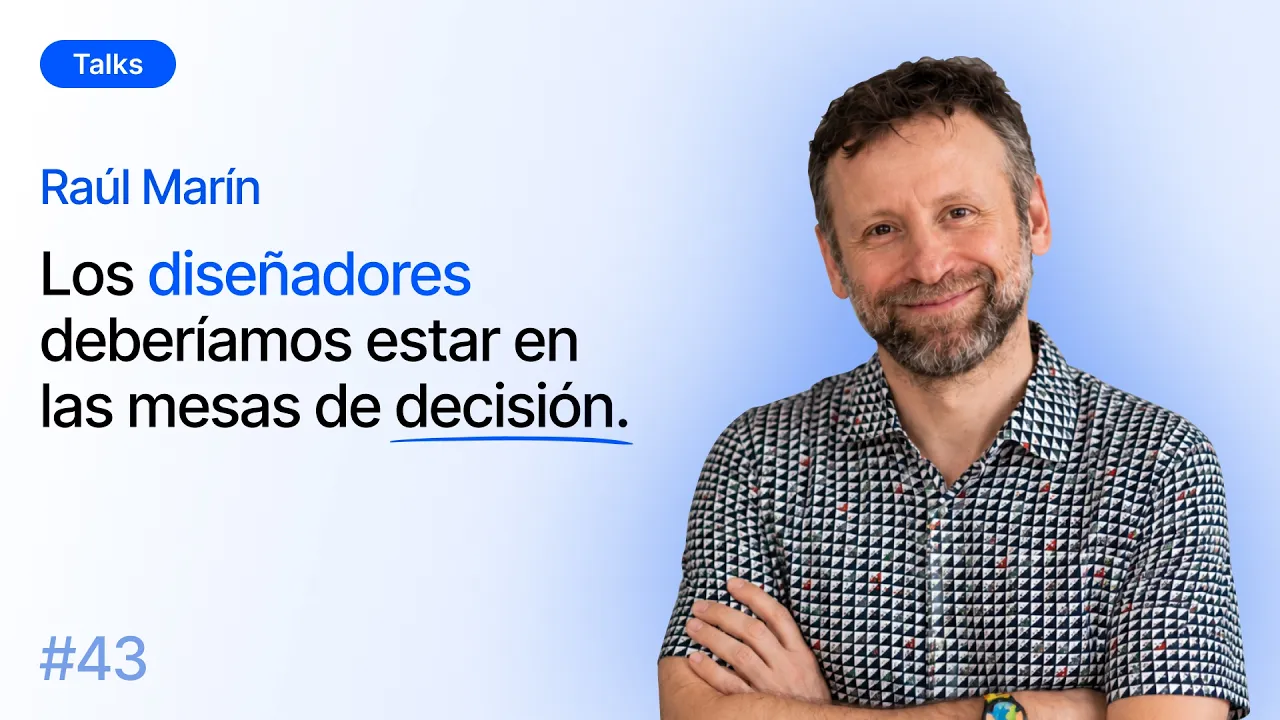
We discuss what is lost when everything starts and ends with AI (critical judgment, curation, the slow thinking of pencil and paper), the temptation to jump straight from the old to the new, the tough times for juniors, the return to craft as a counterweight, and what future interfaces will look like. For Raúl, a designer is not so much defined by what they produce, but by their way of seeing.
Raúl Marín: shiftr.pro · linkedin.com/in/raulmarincalleja
Full episode transcript
Introduction
Raúl Marín: There is a lack of critical judgment regarding what surrounds us. Everything is consumed completely recklessly. LinkedIn and YouTube are full of snake oil salesmen, and what that does, on top of everything, is generate an enormous amount of FOMO and anxiety among designers. Interface design has become heavily standardised: websites are practically all identical, as are applications. I do believe there is a need to explore new interfaces, but the transition forces us to continue consuming a lot of classic interfaces. In fact, it blows my mind that, after having visual interfaces like the ones we've had for the last 20 years, suddenly now, to connect with machines, we've gone back to something from the 1970s like the command line.
Raúl Marín: I always see designers deeply immersed in their micro-world of aesthetics, of what looks cool, of what ought to be, of user research, but I often see them utterly disconnected from the decision-making tables where things are actually decided. We've lost a battle there over the years—one that, with the maturity of design, we could have seized. Brands, on the other hand, have tended towards a kind of subtle ability to continuously transform; they are more flexible. That is a truly wonderful thing.
Guille: Does it make sense for a product designer to understand the physical, analogue product? I'm referring more to product design culture, like Olivetti or Braun. Do you think that's necessary?
Raúl Marín: We already take the finished product for granted. In fact, production is no longer a problem; the bottleneck, as the experts say, is no longer producing. So we'll have to place value on other stages, and I think one of them is knowing whether anyone actually wants this. The current problem is distribution—reaching people. Although it always was; I don't think that's anything new. The thing is, before, there was perhaps less noise. One of our fundamental skills is curation: saying “this way yes, that way no, this is more desirable…”. I believe we have an opportunity now to reintroduce the user's voice into those processes, along with what well-crafted design, a well-made product, truly means, because I think that process is being lost.
Raúl Marín: All I see is people starting with AI and ending with it. And I think they collapse under their own weight every week, because you realise that you yourself forget the launches, what they keep releasing; but momentarily, on that day, it feels like your heart skips a beat. They sell us the cure for cancer, but in the end, they just make funny videos for TikTok. Everyone is obsessed with AI, and in those plans, obviously, money that goes to AI is money that doesn't go to a junior. It all seems geared towards having only seniors managing agents. Replacing a junior with an agent strikes me as utterly obscene, but that's what's happening among those who run companies from a purely economic and efficiency-driven perspective.
Beginnings in design
Guille: Good morning, Raúl. Welcome to Brands 4 Future. How are you doing? How are things?
Raúl Marín: Hello there. How are you? It's an absolute pleasure to be invited here, so let's see what comes of it.
Guille: Let's see what comes out of it. The pleasure, naturally, is entirely ours, having you willing to take part in what I hope will be a hype-free conversation.
Raúl Marín: Always. I think people who know me know that I lead—perhaps it sounds pretentious—with honesty, always. And there is an awful lot of hype in the sector. In fact, I think it's one of the great (I know one shouldn't use the word) plagues of our time.
Guille: With all this explosion that we'll talk about shortly, because this could easily take four hours (I don't know what our time limit is), we're bound to fall short, because the hype is as vast as the time we'd need to recount it all.
Raúl Marín: We'll get into that in a moment, but yes, heaps of hype on all sides.
Guille: To begin with, AI is both the present and the future, but I always like to start at the very beginning. Tell us about your beginnings in the world of design and, as someone with a substantial track record, how you experienced these transitions: the web boom of the 90s and 2000s, mobile applications… How did you get into design?
Raúl Marín: I hope I don't end up sounding like an old codger spinning war stories, but I'm certainly of the age for it. I've been linked to the design world, as a designer and as a lecturer, for—it sounds terrible—almost 30 years. I started very young, at 17 or 18, and of course, I am the age I am now. It's great because it gives you perspective on things like what's happening now and allows you to say: “Bloody hell, we've already been through similar crises, so to speak”. My background comes from journalism: I studied Journalism, which might seem somewhat disconnected from design, but back then design was not professionalised. This is important, because even if it doesn't seem like it, it is now. Apart from the courses available today—although Spain has quite a limited design culture, or one with room for improvement (we'll discuss that later)—back then, it simply didn't exist.
Raúl Marín: I broke into the field primarily through the publishing world. I've always been a massive fan of books and layout design. In fact, my first steps were at elmundo.es, alongside people like Mario Tascón, for instance, who later went on to set up Prodigioso Volcán. My connection was always very tied to journalism, but from the perspective of layout and visual design. Alongside this was the advertising side: what is now the AI hype was, in the early 2000s, advertising—that was the big hit. The El Sol Festival, in fact. That's actually where you and I met, Guille.
Guille: Well, though you met me a bit later; you're making me sound terribly old.
Raúl Marín: It was a little bit later, but what I mean is that it was through advertising training that I had my first interactions with design. Then came the whole mobile explosion and, before that, the dot-com bubble—that explosion of projects or companies that looked like they were going to work out and didn't, and we had to wait quite a few years. Then the mobile boom, and now we have this one, which is like a third or fourth revolution. I think those of us who have lived through a lot of time have a kind of advantage: having survived those and knowing that whatever comes next, we'll manage fine as well.
Guille: And do you think this revolution is very different from previous ones, or is it more similar than many people think?
Raúl Marín: I think there is one subtle difference. All revolutions, or crises, or whatever you want to call them, share similar traits, but what makes this one markedly different is the speed. When I spoke about the early days, we shifted to digital, apps appeared, but it was all far more gradual; there was a transition. Now, I don't know how you see it, Guille, but what I see is people attempting to jump from the old to the new without transitioning, without any hybridisation of the step. That is the greatest difference I see.
Guille: Yes, because perhaps people were saying the adoption of AI was taking too long, and to me, it seems quite the opposite.
Raúl Marín: Yes, absolutely. I was chatting about this a short while ago with a colleague: I don't think this is sustainable over time either. This year we'll probably realise a lot of things—without playing Nostradamus here—but it's clear that this pace and this reckless implementation that most companies are carrying out cannot possibly continue like this. I think we will reach that famous plateau we all aspire to, putting AI in its rightful place and continuing with processes of a more (I won't say classic) automation-oriented nature, rather than purely agentic. That's how I see it.
Design education
Guille: Before we dive headfirst into all of this product design and its connection to AI, I also wanted to ask you about your role as an educator over all these years. Have you seen a shift in students, in content, or a certain professionalisation, as you mentioned earlier?
Raúl Marín: Yes, absolutely. It's been many years. You know I really dislike talking about myself—I always skip it—but we used to talk about training that was more graphic design-oriented. In the 2000s, we also moved towards digitising that content; that is, we needed content to work across different kinds of products, and that has been particularly true from 2013 or 2014 onwards. Bootcamps sprang up, heaps of formats emerged attempting to compete with something that I know sounds controversial: public education, with which evolution is tough, with all due respect. I mean that it serves other purposes, but perhaps preparing people for the reality of the job market isn't its greatest strength. Training has indeed changed a lot.
Raúl Marín: Students have changed as well, but firstly because you grow older yourself (in this case, I'm getting older and have a different perspective), and secondly because the consumption of visuals, the consumption of design, happens in a vastly different way. I come from the era of record covers and printed books; nowadays everything is consumed far more rapidly, and there is no investment, from my perspective, in physical design. Everything is more liquid, more liminal; everything is more blended and evaporates quicker; there isn't the same scope for having reference points as we used to have. I find it very difficult for younger people: when I ask you for your references, I don't know who they are. In our day, they were crystal clear; we had these specific ones. And now, anyone can be a reference: from a YouTuber to anyone who produces good design.
Guille: And that issue with reference figures is also somewhat tied to the whole hype phenomenon, because many reference figures essentially thrive on hype, on alarmism, on “look what happened today”: not even what happened this year, but what happened today, brand-new model of X.
Raúl Marín: The thing is, Guille, we would have to define what a reference actually is. I have my own doubts about that too. People refer to me as a reference, and it always makes me cringe a little. I believe a reference isn't something you plan: you don't just stand in front of the camera and do it. A reference is someone who connects with people and, in some way, helps them—I like to think—to simplify the complex, to understand what is happening, or to stop worrying that whatever is happening will impact them negatively or positively. What I mean is that a reference is anyone you can look to, learn from, or who inspires you to do things you hadn't considered doing. But nowadays, as I said, anyone can be a reference. And you asked me what students are like now, or the younger people I spend time with: I think there's a lack of critical judgment. It's a word I didn't want to use, because I've been criticising it a lot lately—people talk endlessly about 'taste' and 'discernment'—but it's true that there is a lack of thought, as some colleagues put it, of more critical thinking regarding what surrounds us. Everything is consumed completely recklessly. And you said it yourself: LinkedIn and YouTube are full of snake oil salesmen, which also generates a massive amount of FOMO and anxiety among designers, I think.
Guille: Of course. And what is the solution to that? Does it revolve around critical judgment, which we could translate into more theoretical thinking, more philosophical thinking, if you like?
Raúl Marín: Look, I don't think there's enough talk about returning to the classics to think; about pausing, about not rushing so much and thinking more slowly. I couldn't tell you how to solve all this snake oil peddling, because, just as happened with crypto, with the crypto bros and all that, the “hustle bros” emerge on the back of dropshipping: there are trends promoted claiming you can become a millionaire with this and own a Lamborghini. Against that, what can one do? I find it tough, but that's where what you asked me for at the start comes in: honesty. We ought to return to ways of understanding communication, references, and doing things in a more personal, community-driven way, which is something I'm very involved in right now. It sounds awful to say “involved”, because it makes it sound like you're running a business out of it too, but right now I'm primarily interested in connecting people, and I believe that helps fight snake oil peddling. It's one of the avenues.
Guille: And you, speaking from a standpoint deeply rooted in education, what steps have you had to take to adapt to so many changes? We speak of AI, but there have been other shifts: the emergence of Canva, Figma, or Sketch. I vividly recall how websites used to be designed in Photoshop.
Raúl Marín: Totally. And there we were with Flash, Dreamweaver, and even before that. Mind you, I told you I started out in the publishing world, which means I started with tools like QuarkXPress, in the early days of InDesign; then we had to make the leap to “what you see is what you get” technology, Dreamweaver, Flash, then Fireworks went, Sketch… we've been through every single tool. How did I keep myself up to date? It was easy for me, Guille, I tell you honestly, because I think I'm a naturally curious person, but also, as a teacher, you have a commitment (I've felt it, though I don't know if everyone does) to try and provide the latest updates and act as a curator for the young men and women sitting in front of you.
Raúl Marín: That's why I think it wasn't particularly difficult for me, because it stemmed from that curious and proactive attitude. And what I can recommend to anyone watching this podcast is that what makes you most valuable is your proactive ability to stay on top of things. But of course, how do you stay on top of things? I think it used to be easier. I also moved on to the layer you mentioned: canvas-style tools like Figma, multiplayer, SaaS, designing in a browser. The lovely thing until now was that it was gradual: I didn't switch from Sketch to Figma within a week. Nowadays you do: companies focus so much on televising themselves (even if there are no televisions, social networks are their broadcast channels), they compete with one another and push the need to overhaul your process, when I believe we are neither ready nor do we need to at that pace. So, by way of advice, I still recommend using social media not so much for entertainment in the style of TikTok consumption—to have a laugh before going to sleep—but to pay close attention to the views of people who, to me, are true reference points.
Guille: In fact, it's bound to come up. Who are your references, Raúl?
Raúl Marín: Ask me later, if you like, not right now. My references are probably people whose names aren't widely recognisable, but who, when they speak, hold an opinion grounded in their experience, in the time they've spent testing a tool, or in conversations with someone influential that left a lasting impression on them. I see it as something very cross-disciplinary. That is the recommendation I would make to anyone looking to stay abreast of what's happening: don't just read what interests you and aligns with your view; listen also to people who say the exact opposite of what you think; that enriches you considerably.
Guille: Right, I will ask you about those references later.
Raúl Marín: Let's leave it for the end. They'll be old-timers, mind you, I'm telling you now.
Guille: The thing is, when you talked about where to draw that knowledge from, what always springs to mind for me (it's complex, but it always comes to me) is learning as much as possible about aspects of anthropology that might be useful, sociology, history—at the end of the day, the humanities, where you can drink from knowledge that, regardless of the technology you use, will always be intrinsic to human beings. That's precisely where that hype-free knowledge can come from.
Raúl Marín: In fact, many people entering the world of design ask you: “How can I become a better designer?”, and it seems they only ask for books related to Gestalt, to colour… When what really matters is precisely what you're saying: music, cinema. I believe the best influences that feed into design… A designer is an extraordinarily multifaceted being: things of all kinds influence them. Being a vibrant, engaged person is what truly makes a better designer, I believe.
Standardisation in design
Guille: Also, specifically regarding design: you have an issue with the word “critical judgment”; I have a bone to pick with the word “creativity”, with how the worlds of design and advertising have co-opted that word, as if an engineer couldn't be creative. But anyway. As for creativity in the most clichéd sense, I've noticed that—precisely what we discussed regarding the dot-com bubble—interface design, originally primarily on the web and later across other systems, has become heavily standardised. Naturally, what works gets repeated, but this has also resulted in websites, or apps, being practically identical. From a very blunt standpoint, I'd say they have become boring compared to the websites that offered surprises, which you might not have fully understood in terms of user experience, but which possessed that labyrinthine charm of “what am I going to stumble upon?”. An example I love is the ability to apply skins to Winamp. That has no place in design today, because it isn't about efficiency.
Raúl Marín: Yes, perhaps, but I think it's also becoming a bit polarised. I see spectacular pages every day; that's still out there too. The thing is, sometimes it's harder to find them, because you have to go to Awwwards or very specific sites. But you're right.
Guille: And to borrow from one of the leading figures in Spanish design, Wences Sanz, who back in the day founded Domestika and is still making waves out there. He has a very famous talk addressing precisely the homogenisation of design, those times when we went online to discover things. It sounds a bit like a tedious teacher, but let's remember that browsers had names like Safari, Explorer: in principle, they were places to visit not to find the same old things or patterns, but to seek out surprise. Remember the days of Flash. Not that I want to return to Flash, but one must acknowledge there was an era when visiting a website meant discovering what was happening there: where the menu would be, what the experience was like.
Raúl Marín: It's true that those were also times, as with anything new, that were more exciting. I'm not saying they aren't now, but the industry has evolved towards delivering utility, towards enabling people to use things, and that requires certain patterns: to submit your tax return or buy a handbag, you shouldn't have to wander around wondering where the shopping basket is. Some things have to be made uniform so that they work, with the proper form and usability. But you're right that we've ended up perhaps overly uniform, and that is even more visible now with AI, I think.
Guille: Of course, absolutely, because AI gravitates towards the average; or it gives you the average, that mediocrity that we all carry inside us as well.
Raúl Marín: And that's why I mentioned it, because over the last 10 years I've been working on design systems, which is a layer with massive implications for this concept of homogenisation. And I'd like to think the blame doesn't lie with design systems; whenever I can, I say so. I think it's more about how we use them: since we don't want to rack our brains—and tying back to that creativity you mentioned—we take it for granted that it's better to follow rules and patterns than to rack our brains to build a different experience. But I think we're all to blame, you know? It's very difficult.
Guille: Yes, because it's linked to user experience and, clearly, the other side of the coin is: look, let's make things usable. You can't just… not everything has to be hyper-experiential.
Raúl Marín: Of course. But consider, Guille, that that era I was lucky enough to experience a thousand years ago, which was more experimental, was also part of our lack of experience: we were very young, very wild, everything was new, and when something is new, you take more risks. And I think later it was discovered, and applied with all the good sense in the world, that usability and accessibility are essential, because not everyone has the desire, the time, or the need to go online looking for creative experiences, as we discussed earlier. But yes, the web has become homogenised. Wences said it in that talk back in 2016 or 2017, and we haven't improved much.
Guille: This question stems entirely from Wences' talk, which has been spinning around, doing cycles in my head ever since.
Raúl Marín: Yes, absolutely, that's just how it is. I think it was at a UX Spain, if I'm not mistaken.
Guille: Yes, I'm not sure if it was at a UX Spain.
Raúl Marín: At a UX Spain, I believe it was.
Guille: It doesn't matter anyway. The point is that it remains entirely relevant and can be brought into this conversation without sounding out of place, many years later. And with AI now, I really do think the homogenisation is blatantly obvious. Every time you generate a website mockup, out comes that terracotta-toned site in the style of Claude; we've turned to UI kits… I've always been an anti-UI kit activist, as a way of defending custom design—I don't like them much—and suddenly we are yielding to shadcn, to frameworks like Tailwind, precisely so that AI can better understand what we do, because now AI is the user persona, or the target we must aim for to give value to what we make. It feels a bit tyrannical to me.
Raúl Marín: Yes, I think the mouse and keyboard are limiting as well.
Guille: Naturally, because, for instance, I find that the issue isn't necessarily design systems, and proof of that lies in video games, which have their own design systems. I think of Fortnite, or any GTA or Red Dead Redemption: I see that they have their components, their cards, but they've played in an entirely different direction.
Raúl Marín: Yes.
Guille: And that's also the aesthetic of video games, whereas the web has its own aesthetic, which is more minimalist.
Raúl Marín: Well, I think in the end video games have achieved something wonderful (though I'm no expert, and obviously there are many types of gamers): they've managed to give them a distinct personality, which allows them to play with those kinds of freedoms. But in the web world, we have largely surrendered to the concept of “it must be like this because that's how it's done”. We follow trends far too much, certain currents that perhaps we ought to have broken away from at some point: those chains of pattern obsession and the like.
No-code and Vibe Code
Guille: Yet I think one of the things that has disrupted this slightly is the rise of Framer, Webflow, and so on. Though I also see complaints along the lines of: “Look, I just want to read this webpage without scrolling 150 times and having it zoom in on me 20 times”.
Raúl Marín: Of course, you touch upon the subject of no-code. It's true that no-code existed before: earlier I mentioned Dreamweaver, FrontPage, and that sort of thing from the first era; later WordPress came along. But what no-code had, from my perspective, was that it held design very central. I've been quite an advocate of that sort of niche, because ultimately that's what has remained: it felt to me like it brought a certain philosophy of “design matters”. Framer, Webflow… every tool even possessed a personality in terms of the kind of people it attracted. That is crucial: the people who turned to Framer, or no-code tools, were looking not just for ease of use, but for personality—a design-first attitude. The downside, as I see it, to bring it up to date, is that its peak has been somewhat dampened by the arrival of AI, because now vibe coding is what has overtaken no-code, even though they aren't the same thing. And it's a real shame, because I'm a huge fan of Framer—I absolutely love Framer—but it was also conceived around the concept of a landing page, a quick page, an MVP project. And now AI “mediocritises” that (I doubt the word exists): it turns it into something more mediocre and ruins it a bit. I see tough times ahead for no-code.
Guille: And combining vibe coding with these kinds of tools that allow, for example, having a CMS that anyone can use, and so on.
Raúl Marín: Of course, the trouble is that I think no one is tackling it properly. I was talking about Framer, and I like Workshop, which is their AI side, but it feels relegated to just generating sections of a page. And what I see is that we are losing the patience required to build good products: we want everything instantly. So AI is unbeatable, because you feed it a prompt and it spits something out. And these tools where you have to work with inspectors and whatnot are great, but I think they are being left behind by iteration. Do you see what I mean? Claude Design, Replit Canvas, which launched very recently, V0… all of those are vibe coding tools, or chat-based AI, with an inspector tacked on, like Figma Make. I don't know how useful that really is, because all of it remains subordinate to the underlying AI. I'm not sure if I've explained that clearly.
Guille: Yes. It's also very different depending on whether the person vibe-coding is a designer or comes more from an engineering background.
Raúl Marín: Of course, absolutely. But what I mean is that, for example, I notice that all tools have their visual layer so you can tweak things, but I wonder if it's somewhat corrupted, because in the end what you're doing is prompting underneath; it's not a direct change, you aren't moving anything yourself.
Guille: Exactly, you can't have pixel-level control. That's why I saw the potential in using AI alongside a CMS, like Framer's CMS, or being able to manipulate the pixel, or build from scratch, which is more the engineering side. What genuinely interests me in a design tool is one that lets me use AI whenever I want and push pixels whenever I want, at least during this transition towards whatever comes next.
Raúl Marín: I believe that will come.
Guille: Yes, but at the moment no one is pulling it off properly.
Raúl Marín: I try out everything that moves, and what I notice, Guille, is also a push towards pure code: towards turning designers into design engineers, saying we need to be embedded in pure code now, working with tools that have code integrated. But we are setting aside the most creative and beautiful part, which is being able to apply colour, remove it, tweak it, without having to resort to AI for it.
Guille: I believe so. And using AI specifically for interface design, to design the interfaces we were already building, is a bit like using a tool of the future to make things of the past. So I think about people who primarily write code with these kinds of aids: how could we break away from the patterns we've been dragging along?
Raúl Marín: We are showing—you're quite right—very little vision and innovation in what we do. Though I must say I do see people doing really cool things: skeuomorphism has returned, for better or worse. I notice people trying to break out of 2D and flat design, turning products, and indeed the entire concept of interfaces, into something unrelated to touch, focusing instead on audio, virtual reality—which seemed to fizzle out slightly with the metaverse hype, but it's still there: Apple Vision, all that jazz. I think there is indeed a need to explore new interfaces, but the transition forces us to keep consuming a lot of classic interfaces. In fact, it blows my mind that, after having visual interfaces like the ones we've had for the last 20 years (graphical user interfaces, as the experts call them), suddenly now, to connect with machines, we have returned to something from the 70s like the command line. I see tremendous advancements being made in something as ancient as a command line, which is basically throwing instructions at AI because it's a machine. It's curious: we look to the future, we want Ray-Ban smart glasses or whatever, we want an immersive experience, and yet we are beginning to operate brand-new technology using an approach from the 1970s. It's rather odd. I don't know if I've gone off on a tangent.
Guille: Not at all. I think historically it happens that this is a transitional phase where we ourselves want something, but we don't know what, and we keep pressing buttons until the right one clicks. I also acknowledge that people are innovating. Not long ago I saw an experiment from Google, by the DeepMind team, that detects intent in what you're about to do with your cursor. The whole voice aspect within AI tools is important. I'm not a heavy user of it myself: I don't talk to AI to tell it what I want it to do; I don't use voice prompts. But I understand that spoken communication is vastly different, in terms of reflection, from written communication. On that front, I do see a lot of people—I don't mean endless WhatsApp voice notes…
Raúl Marín: Right, yes, absolutely, but extracting more nuanced information, perhaps, by using that interface. When we speak we are more expressive, but we are also more redundant.
Guille: And less precise and less reflective. Also because writing forces you to synthesise.
Raúl Marín: Of course, but perhaps more expression is required to grasp the concept through all the words you use, rather than something so constrained by your phrasing. In fact, there is also plenty of debate about whether to prompt in Spanish or English: written language carries a certain power to steer, to bias, what we produce. But frankly, I don't see any real advancement or shift in interfaces simply because AI has appeared. There are experimental things, but nothing truly mainstream.
AI and accessibility
Guille: Changing the subject slightly, though not entirely: when what is known as digital transformation, the digital revolution, arrived, I noticed that this—which seemed hyper-innovative and poised to solve countless problems for people—also erected a barrier, a wall, for less tech-savvy individuals: the device itself, the mobile phone, the computer, and the very concept of an application. We all have older people around us who struggle, even 20 years after all this took off: “Look at this app for me, the bank sent me something, they told me I have a notification, that I need to enter a code, fill in a form”. For younger people it was an extraordinary leap forward, not having to physically queue up for bureaucratic tasks, but for others, it was an obstacle. Do you think AI can resolve this, for instance by allowing them to communicate via voice?
Raúl Marín: If it only gets rid of those wretched contact or sign-in forms, I'd be happy…
Guille: Yes, forms in general.
Raúl Marín: Forms in general, right? Absolutely.
Raúl Marín: I was going to say it's curious, because I think the generation that has suffered this struggle with technology came from a vastly different era. I don't know how AI will affect people who are already tech-savvy, because we aren't that same generation. I'm talking about my mother: she's 80 and obviously never experienced adopting technology early on, because before that, there was nothing even remotely comparable. But us, you, me, people who have spent the last 15 or 20 years glued to a smartphone, I think AI should come to us far more subtly in terms of adapting to whatever is new. But I don't know, because I also don't know how fast it's truly arriving. I have a bias, which is working with designers, with people dedicated to this field. I can tell you that out there, in my local neighbourhood, I don't see people eagerly waiting to see if OpenAI drops the GPT-5 model.
Guille: Yes, but, for instance, mentioning your mother: do you think that with AI she could do things she finds terribly difficult on a phone or computer far more easily, using voice?
Raúl Marín: In fact, a couple of weekends ago I was at Recreo, one of the events I organise, which involves travelling to places I love to describe as (borrowing the phrase) “exotic design”. We were in Badajoz, in a village of 4,000 inhabitants, gathered with the local residents, among whom were older people. And we were discussing precisely whether AI could present an opportunity to somewhat alleviate that disconnection we know exists with the digital world. But I don't know if it's so much about us organising activities and the public sector investing in this, as it is about people's own attitudes and the environments in which we live. If your environment is technical… For example (now that I mention my mother again, I can play this back for her later and she'll be thrilled), I set up artificial intelligence for her when I go round for lunch and get her to talk to it. I think that would be the way forward: trying to introduce technologies like this—which is also very approachable in terms of familiarity (I don't mean cost)—in a gentle, unforced manner, unlike companies insisting “you must use AI whether you like it or not”. I believe it will be much easier to adopt if we integrate it naturally. Forgive me for rambling a bit, but I do believe it is the technology that can help make everything easier.
Guille: I think it has an accessibility angle as well, and, looking further ahead, having agents that assist people who find things harder, for whatever reason (not just age), with paperwork. I always think of the thing I despise most: bureaucracy.
Raúl Marín: Totally. Perhaps it will be us in the future who need it. The present moment is too early, because we aren't achieving the successes that are supposedly predicted. AI is highly aspirational, very much about “we're going to do this”, but as of today, let's face it—as much as it has advanced over this last year or two—it remains very unrefined in terms of that non-deterministic nature it has, which is maddening for most of us working in this field, because it doesn't allow us to conclude with the quality or determinism, if you'll excuse the repetition, that we want.
Guille: Yes, having certainty.
Raúl Marín: Certainty. We are in a world of uncertainties, and that is profoundly disheartening because of the anxiety it produces.
Design culture
Guille: Let's come back to the present and discuss the current state of product design in Spain. You mentioned earlier that there could be a stronger design culture in Spain, but I think that, overall, we are appreciated both here and abroad as designers. The talent is there. The issue is that I see a vast divide between designers and pure, hardcore code-crunchers. That's an impression I get, and one I think is better resolved in other countries. I don't know whether that's down to hybrid profiles or…
Raúl Marín: Sure, I couldn't really compare this to abroad versus what happens here in Spain, but it's clear that there are exceptionally good designers here. You go abroad and ask, and people associate us with design in many respects. We've had great designers and we continue to have them. But what I meant, as I mentioned earlier, was more about design culture, which is different: whether a company has a design culture is a local or organisational matter; it's more about the day-to-day, and also about the cultural resonance design has at a societal level. There is still a pressing need to embed design as something more core within companies. I still see designers treated as expendable (I use this word because, right now, as AI seems to be triggering quite a few layoffs and redundancies, I notice that phrase resurfacing: “we can let the designer go, because they seem like an intermediary and expendable”). I don't think we've gained as much ground, Guille, and mind you, we've matured a lot—or at least I thought we had. I don't want to fuel FOMO for the people listening to this, who will mostly be designers, but many designers are being pushed out of companies as the first wave of people deemed expendable due to AI.
Guille: I think Brian Chesky mentioned this at a Config: he spoke about how, just as engineers are held in high regard, design carries a comparable impact.
Raúl Marín: Brian says that because he is a designer himself, if I remember rightly, and Airbnb has championed that philosophy. But I look at Spanish businesses which, if you set consultancies aside, are largely SMEs, and there remains an absolute lack of basic appreciation for design. And in fact, AI isn't helping much, because AI turns you into a designer, just as it does a programmer, with a single prompt. Every day, and it breaks my heart, I see scores of people saying: “Look what I've designed”, and it's an absolute piece of rubbish, yet that person thinks it's pure genius, simply because they made it themselves, or because they never felt capable of putting together a half-decent colour palette and now find themselves doing it.
‹ Marco Creativo - Branding, design, YouTube, and Artificial Intelligence | B4F #42
Brandfy - The Spanish startup to design brands with AI | B4F #45 ›


