Brandfy - The Spanish startup to design brands with AI | B4F #45
Category
News
Date
Duration
2 minutes

In this new episode of Brands 4 Future, we speak with Carlos Hermosilla, founder of Ideolab, a design and branding studio from Vitoria, and of Brandfy, an AI platform for designers to create brand identities.
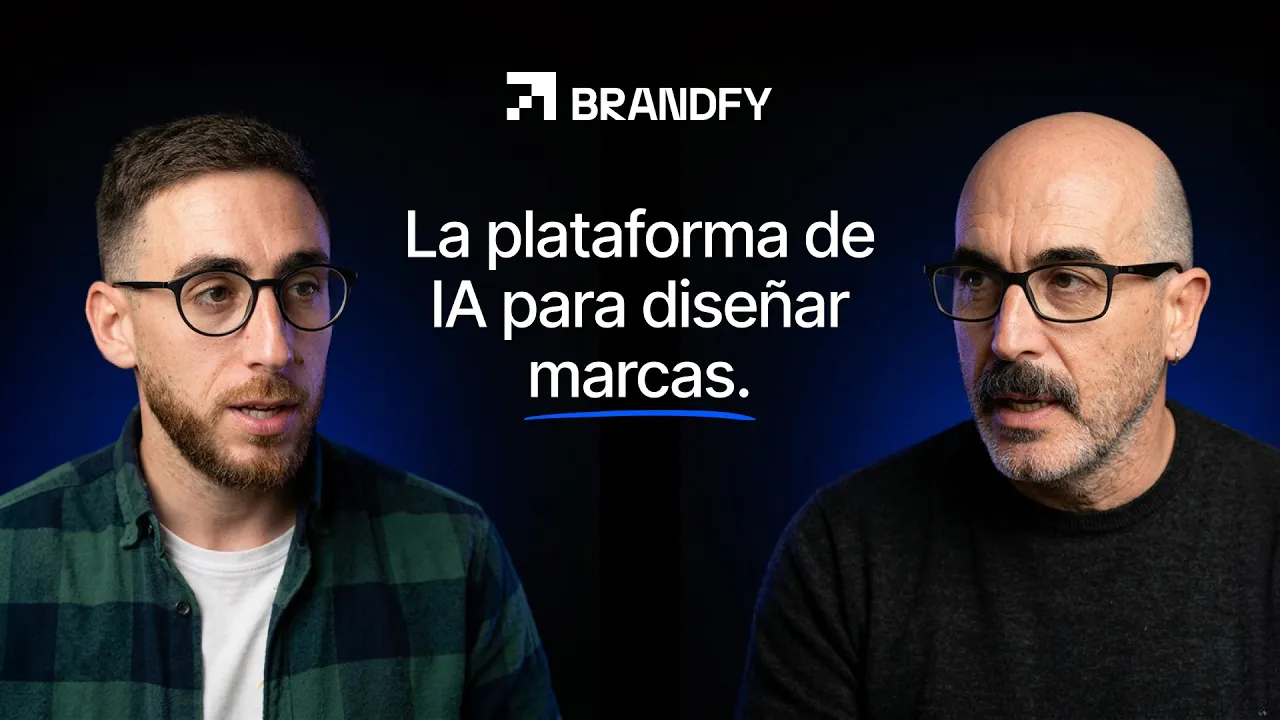
Carlos shares how Brandfy was born: a client who ended up becoming his partner and CTO produced in 30 seconds, using a model not intended for branding, the concept that took his studio a month and a half to develop. Hence his conclusion that 99% of the creative process is technique. We also discuss how the platform works, their proprietary model fine-tuned on an open-source one, funding, haters, designer profitability, and what happens if OpenAI or Anthropic launch something similar.
Brandfy: https://brandfy.ai · Ideolab: https://ideolab.com · Book recommended in the episode: Just My Type: A Book About Fonts, by Simon Garfield.
Full episode transcript
Preview
Carlos Hermosilla: What we did was say: “This is going to overtake us”. We tried to identify what problems we had in the studio and we spoke to designers from different parts of the world. They were all more or less telling us the same thing: about time and profitability. It was a bit like facing ourselves in the mirror and saying: “I thought I was using creativity here, but it was technique. 99% of it is technique”. We launched an initial prototype in February 2024, and on the first day we had 800 users. Within two months we reached 3,600.
Guille: Who is Brandfy aimed at? Is it for the general public or for designers who already have a solid background of knowledge?
Carlos Hermosilla: Absolutely for designers. The more knowledge you have, the better. It is just like Photoshop: if someone wants to use Photoshop, they will be able to, but the result obviously won’t be the same as that of a designer who has been doing it for 20 years.
Guille: A common saying is that artificial intelligence funnels everything towards the average of what has already been created in the world. At Brandfy, how have you tackled this to try and prevent it from doing the obvious? Does this mean you have built your own artificial intelligence model? Are you not using a model from GPT, Anthropic, or an open-source one like DeepSeek?
Carlos Hermosilla: We aren't afraid of a designer telling us something we don't like. If they say something we don't like, we will first try to understand why—because maybe we are doing it wrong—or understand why that person thinks that way about us. We know that within the creative world, there is practically an ideological rejection.
Guille: Have you found yourselves involved in any controversy of this kind? If a designer told you that Brandfy was going to take their job, what would you say to them?
Carlos Hermosilla: I am aware that Brandfy is neither for every designer nor for every type of project. For example, one designer at a Brandfy presentation told me: “I’ve come to tear down your whole operation, because you’re going to crush us”.
Guille: And aren't you worried that one day you'll wake up and Anthropic or OpenAI will suddenly launch something in Brandfy's space—not exactly the same, but something that could compete with you in some way?
Carlos Hermosilla: I make Brandfy, or we made Brandfy, because I believe it is a relatively logical evolution of the sector. If the way to bring it to market is AI, then let it be AI, just as it once had to be Photoshop, CorelDRAW, or FreeHand.
Introduction
Guille: Welcome to Brands 4 Future, Carlos.
Carlos Hermosilla: Thank you very much.
Guille: Carlos Hermosilla, CEO and founder of Ideolab, a design, branding, and packaging studio, amongst other things, and also CEO and founder of Brandfy.
Carlos Hermosilla: That's right.
Guille: An artificial intelligence platform focused on creating corporate identities, logo design, and so on, which we will delve into shortly. You'll tell us a bit more, as I imagine it's a tool that has evolved over time.
Carlos Hermosilla: Yes, absolutely. First of all, thank you very much for having me.
Guille: Thank you for coming.
Carlos Hermosilla: The original idea for Brandfy, a little over four years ago, had absolutely nothing to do with what it is today, just as Ideolab isn't the same as it was 23 years ago.
Guille: 25 years?
Carlos Hermosilla: 23 years.
Guille: Right, I had 25 years noted down here; I don't know where I got that figure from.
Carlos Hermosilla: Well, more than 20 years in business.
Guille: Well, the first thing we usually do in these conversations is start by sharing your story: how you entered the world of design, how you got into branding, and, if you like, we can link that to how you founded Ideolab, as you aren't the sole founder. Tell us a bit about your journey into this world.
From analogue to digital
Carlos Hermosilla: I'll tell you. First, I studied film and television. Out of the fields available at the time, I was very clear that I wanted to pursue photography. When I was in my final year, I discovered Photoshop—virtually the very first version. I kept badgering my photography teacher because I knew he had a mate who worked with Photoshop, and I worked for a long time to afford that private course. I immersed myself in Photoshop. We're talking about version 2.5.
Guille: Blimey! So, CS2? I think that's what it was called at the time.
Carlos Hermosilla: No, long before that.
Guille: It wasn't CS3 or CS4, which is when I started.
Carlos Hermosilla: No, no. Way before: 2.5, 3, 4, and I think later it changed to the CS line, right?
Guille: Yes, that was version 8.
Carlos Hermosilla: Of course, because that was Creative Suite, which already came with Illustrator and so on. I started to realise I was interested in other things besides photography. At that time, I was working as a photographer in Paris and, meanwhile, doing some freelance retouching work for photography books and a few prominent brands. I said: “I want to learn more things”. I enrolled in a design school and from then on balanced freelance Photoshop jobs with my studies.
Carlos Hermosilla: When I returned to Spain at the end of '99, I started working as a very junior designer—I was very young—and was promoted very quickly. Meanwhile, and throughout my entire career, I educated myself with lots of books and attended every course I could. You also have to keep in mind that I was in Vitoria. That's something I like to mention: once I arrived from Paris, I gave myself a few months to see whether I would start working here or not, and I started straight away. I worked at a multinational running what was then UX. Imagine what that was like back then.
Guille: Yes.
Carlos Hermosilla: Then I moved to a tiny studio, because I wanted to experience what a small studio was like, and after about a year and a half, I decided I wanted to set up my own. On day one of starting out, I got a call from a big Madrid studio that I loved, but I had already decided that I didn't want to live in a big city.
Guille: So you liked Vitoria. The main motivation to start a business was being able to stay in Vitoria, wasn't it?
Carlos Hermosilla: It was to work on projects that interested me. Being in Vitoria is very comfortable for me. Where our studio has been based for a long time, right outside there is a huge park with deer, for example, and I go out for walks to watch the deer.
Guille: I believe Vitoria, if I'm not mistaken—speaking from memory—is one of the cities with the highest quality of life in Europe.
Carlos Hermosilla: Yes, it is. We were European Green Capital in 2012, which was also a big milestone, but the quality of life here is very high. At the studio where I worked in Paris, I had an hour-and-a-half tube commute, and I said: “No, no more of this”. On Ideolab's first day, I got that call from Madrid and I didn't go. Well, the proof is that 23 years later... Sometimes you mull it over and doubts arise, don't they? But to put it into context: we have developed over 100 projects across 15 different countries, and I'll tell you about my fellow co-founders in a bit. We've worked from Vitoria with China, with the United States, and many others. Our latest major project was done in the Emirates, for example.
Carlos Hermosilla: Things kept coming up. What we certainly did a lot of, because I loved doing it, was work alongside designers I admired; I would badger them to let me visit their studios, watch them work, and learn. I learned a great deal, and also benefited from the generosity of other designers: top-tier designers sharing everything with me when we hardly knew each other is something I have always tried to emulate.
Guille: Well, you see, that is part of the purpose of this podcast: being able to meet people you might otherwise never cross paths with, discover projects, and learn. I really connect with your point about how things used to be done differently.
Carlos Hermosilla: It was entirely different. For instance, I spent months travelling to Madrid on Saturdays to learn motion graphics with a designer I loved, Tomás Peña. It was the only way to do it: I go to Madrid every Saturday, there and back, and that's that.
Guille: Besides, we come from an era—I think I caught the tail end of it—where you learned design by doing. There was no formal degree; it was more of a trade, something you learned like a craft.
Carlos Hermosilla: Nowadays, even the fact of having a computer seems self-evident. I remember my first year studying design was without a computer: pure pencil and paper, tracing typefaces using tracing paper.
Guille: Of course, but you have to train the hand as well.
Carlos Hermosilla: I have very fond memories of the design school in Paris. On the first day, they handed us a Habitat catalogue and said: “You have to create a poster between now and the end of the term”, using hundreds of photocopies. Photocopies to learn composition. We didn't touch a computer, and I learned so much about composition—so much. For me, that foundation was vital. Later on, I exhibited my photography in different parts of the world, we started doing interactive art projects under the Ideolab banner, and suddenly brands came along saying: “We want you to do this for us”. That's when Leire, Susana, and I decided to set up the studio, because each of us was working somewhere else. Leire is my partner and Susana is her sister. So everyone gets the picture: we are a family business.
Guille: How brilliant.
Carlos Hermosilla: It has its wonderful aspects, and others where, when you disagree, you take it home with you.
Ideolab, the dot-com era, and Converse
Guille: I'm really fascinated by the period you mentioned when Ideolab was founded, because so much was happening back then. We’ve talked about the purely analogue days, but you also mentioned that in a small studio you started doing what we now call UX. That was right in the middle of the dot-com boom, the internet, the early websites. What was that like? I was very young at the time, but it must have been an exhilarating period, wasn't it?
Carlos Hermosilla: For me, it was incredible. Imagining that every single day we were doing things that had never been done before. I remember a project I was commissioned to do for Icarta: they sent me an Illustrator file, I didn't know what Illustrator was, you open it up and they tell you: “You have to design a platform”. At that time, I at least was designing UX in Photoshop. Imagine that—a complete dinosaur. But it was a non-stop wave of new technologies, new opportunities, new websites that suddenly blew your mind.
Guille: A very creative time as well, wouldn't you say? Because we look back at those websites... I certainly remember them in contrast to today, where there are design standards that, for better or worse, have their merits, but mean everything feels very homogenised. Back then, websites were sometimes mazes where you had no idea where you'd end up.
Carlos Hermosilla: To me, it was pure creativity. Everyone wanted a creative website, not a correct one; or at least that was my impression, especially within the industry. I remember designer platforms where everyone was making the wildest things. The analogue side was brilliant fun. We started collaborating with a magazine, [name inaudible], which curated an issue based on a theme, I can't recall if it was monthly or quarterly. We loved it. I have a piece here that we made for their 10th anniversary: we shredded their magazines from the last 10 years, imagine that, and turned them into paper pulp. In Flash, we created a program that drew randomly using the words most frequently repeated in the magazine over those 10 years; we printed it onto the pulp itself, and with the leftover liquid, we made a syrup. It was a travelling exhibition shown in Berlin, Santiago de Chile, and all across Spain. We were rubbing shoulders with people I found incredible, like [name inaudible], alongside so many people who made you think: “Cor, this is fantastic”.
Guille: It's also about finding clients, businesses, and brands willing to take a chance on such creative projects, where design blurs into art, isn't it?
Carlos Hermosilla: For us, it has always been clear that artistic projects are one thing and design is another. In design, you have to apply technique, even if we strive to be as creative as possible. But it's true that over time we've seen turnaround times—which seemed tight back then—shrink dramatically. Whereas I used to plan a photo shoot a month in advance to handle all the art direction, nowadays there are clients who ask: “Can you pull this together in two days?”.
Guille: Indeed. And if turnaround times shrink, budgets do too, right? In the past, you had a wider financial cushion to produce more interesting work.
Carlos Hermosilla: It depended on the brand. For example, we spent two years handling all the motion graphics for Converse in Europe, and they gave us complete freedom. We produced all the motion pieces for their 80th anniversary, and the only brief they gave us was: “Look, you need to cover these decades, and do whatever you like”. We created animations ranging from The Ramones to Monica Lewinsky with Clinton, without any pushback. Looking back at it now, you think: “We were so punk compared to what gets made today”.
Guille: In fact, I talk about this a lot with designers and people in the industry: the homogenisation we mentioned on the web is also happening to brands, and brands are becoming increasingly politically correct. I think of skate brands, even skate adverts, the VHS tapes passed around full of crashes, broken bones, which later led to the Jackass aesthetic and all that. Today you look at brands in those sectors and a version like that would be unthinkable.
Carlos Hermosilla: I remember a tiny skate brand we worked for: one day I cut myself, I was bleeding, and I said: “This is skating”. We used photos of that blood for parts of the interface. Nowadays, for me, it's a shame that spirit has been lost. I think there is some very good work out there, but homogenisation also limits us.
Guille: I believe that either way—and we'll get onto the subject of AI now, which is always a recurring topic for better or worse—AI will also bring this back to us: since AI produces the ordinary by default, we will have to break out towards more transgressive work. I like to think we have this opportunity to seek out weirder niches, so to speak.
Carlos Hermosilla: Yes, I think so too. Within the Brandfy team, we discuss this topic a lot. I believe handcrafted design will be valued much more. For example, in the case of Converse, if we were making textures inspired by 70s punk, you had to make them yourself. Now I see projects where people have bought a texture pack and just applied that. It's faster, cleaner, more efficient, and certainly more profitable, of course, but it loses that personal touch.
Guille: And the issue is that the speed at which things are demanded forces you to work at breakneck speed. Giving work time to breathe, giving designers the opportunity to take their time, produces more considered results, but we're moving at a relentless pace.
Carlos Hermosilla: It depends a lot on the project. We were recently called in for a major campaign that the client couldn't get over the line. They gave us a week, and after a single day they told us no, we only had four days. Fine, you do it, the project turns out well, the client is thrilled, and that's that. But I also remember that when a client like Converse gave us three weeks, it felt like hardly any time at all.
Guille: Of course, but the tools at your disposal were also slower.
Carlos Hermosilla: I had to physically send a DVD to deliver images or proofs. As I mentioned earlier, when I was doing freelance retouching from Paris, a month might pass between starting a project and sending a CD, and delivery took a week to arrive. It gave you time to think. Nowadays, that can be difficult.
AI and resistance to the digital world
Guille: Do you see parallels between this AI era, this integration of AI into our lives, and the era of digitalisation, the dot-com era, the website boom? Or do you think this is ten times bigger?
Carlos Hermosilla: Absolutely. Look, everything is exponential: the results are astonishing; what we do in design, what we can do in Brandfy is on an entirely different level. But I remember during that early photography phase, when I was an intern at a studio, they'd say to me: “Come to the printers, we're going to meet the retouchers”. The retouchers worked with airbrushes and acetates. I remember a retoucher who painted the steam on photos of clothes irons, imagine that. I would say to him: “I can do this in Photoshop”, and he would throw his hands up in horror. He'd say: “That's impossible, that won't look right”. There was already a resistance towards the digital. Back then, there was resistance to computers: “How can you do that with a computer, when I cut out letters, when I use Letraset?”. Nowadays, there is sometimes resistance towards AI in design, but it's important to understand that AI should just be another tool, and you have to know how to talk to it. The value lies in how you prompt the AI, what you ask of it, with what critical eye, and what room the AI gives you to intervene. Building a complete identity with AI today would, in Brandfy's case, be much easier to develop than what we have actually done—which is allowing the designer to intervene at every stage: editing everything, making suggestions. In an early test version of Brandfy, which we'll discuss shortly, you clicked a button and had the whole brand ready in two minutes.
Guille: Of course. Well, if you like, tell us what Brandfy is to give us some context, and then we can carry on discussing the benefits it can offer designers and so forth.
The birth of Brandfy
Guille: Actually, I wanted to ask you just before that—you'll tell us what Brandfy is in a moment—how did you arrive at the Brandfy moment? What was your lightbulb moment? I'll share mine, if you like: it was when I started seeing those images generated with DALL·E and Midjourney, which were donkeys on the moon, things like that, super rough, but I thought: “Crikey, something is happening here”. Because you write a sentence and out comes a completely synthetic image, pixel by pixel. That was the spark for me. What was that mindset shift for you?
Carlos Hermosilla: Picture this: we were working on a project in Dubai, and the person who is now my partner and CTO at Brandfy was the client, and he kept telling me: “AI can help you guys”. I didn't want to hear it. We're talking about the period before ChatGPT was released, before the whole AI explosion. It's true that Eriz Zárate had already been working with generative AI and trading algorithms; in fact, he founded his first company at 23 and sold it a year later—an applied AI business. He already came with that whole background. So what we did was say: “Right, you keep insisting that this will help designers, while I'm thinking how on earth could it replace creativity, that's impossible”. We fed the brief he had given us at the start of the project into a model that wasn't even trained for Brandfy, and the output it produced in 30 seconds was identical to what Leire, Susana, and I had arrived at after a month and a half of work. It wasn't a simple concept either: it was about how audio waves affect physical objects. So it was like: “What do we do with this?”.
Carlos Hermosilla: It was a real shock. Everything I thought about human creativity, that it couldn't be replaced... Not that it's being replaced now, because I'm well aware this isn't conventional creativity, it's information, but it completely blew my mind.
Guille: I think AI has bruised a lot of egos. I've spent 25, 30, 40 years doing something, and suddenly, at a stroke, practically (I think we will always remain at “practically”), it has left us without that role. It's a person's identity tied to their profession, which is often deeply intertwined: “I am an architect, I am a designer”, and now AI replaces me.
Carlos Hermosilla: Exactly. Then it comes down to how it's built. To me, this isn't a technological problem, it's a human problem. How will we evolve alongside AI? Where will we be in 10 years' time? It will depend on what humanity chooses to do, for better or worse. That's why we have to examine it with a degree of philosophy: about what we are. Forgive me, you asked a question and I haven't finished answering it.
Guille: Well, the moment you realised this was important. You were saying you didn't think it would replace the creative side. I think we all assumed it would be Netflix recommendation algorithms, that it would write text quite well or handle a spreadsheet brilliantly, but I thought: goodness, how could it be better than a film director?
Carlos Hermosilla: For us, it was that moment of seeing the result and thinking: “Hold on, it's already here”. It's not that it's coming, it's already here. And I repeat, ChatGPT hadn't even come out yet. That was staggering. This was prior to ChatGPT, which was when everyone... I'm talking about the spring of 2022; ChatGPT launched in November.
Guille: Yes, to put it into context.
Carlos Hermosilla: So, what we did was say: “This is going to overtake us, let's jump on board”. We have done many tech-related design projects: interactive art, installations in museums, for brands, all sorts. Technology has always been very close to us, or we've been very close to technology. So we said: “Right”, and we tried to identify what problems we faced in the studio. We spoke with designers from different parts of the world, from Latin America, Asia, and Europe, and they all spoke about pretty much the same thing: time and profitability. So we said: “We can build something that helps us and helps other designers”. And that's where the initial idea for Brandfy came from. That's where the MVP emerged, so to speak, or the prototype.
Guille: Or even the pre-MVP, right?, for Brandfy.
Carlos Hermosilla: Yes, exactly. Later we launched an MVP that was barely functional; some parts worked. We spent a long time, over two years and with immense effort, mapping out our brand creation process, identifying at which points there was creativity and at which points there wasn't. It was a bit like holding up a mirror and saying: “I thought I was using creativity here, but it was technique”.
Guille: People often talk about references adapted for a client: I see this, I adapt it. We often call something creativity when AI does it in a very similar way to how we've always done it, which is drawing inspiration from projects or other sources and adapting it to what we're working on. We never reinvent the wheel from scratch either.
Carlos Hermosilla: That's pretty much the point. I used to think we built everything from scratch, and when Eriz said to me: “Right, let's break down the creative process into different steps, into tiny tasks, and see where there is creativity and where there are technical decisions”, it turned out that 99% is technique. A typeface selection depends on a brief and an objective being pursued, and how I represent a concept follows the exact same logic. We started by translating that into AI. We launched an initial prototype in February 2024, which as I say wasn't even fully functional, and on day one we had 800 users.
Guille: Wow.
Carlos Hermosilla: What happened? What other designers had told us was actually coming true. Within two months, we reached 3,600.
Guille: And which channels did you advertise on?
Carlos Hermosilla: We ran a very small ad test, and it just snowballed. People were waiting for an AI product that could create an entire brand. It generated a complete brand right from the MVP stage.
Guille: A complete brand right from the MVP.
Carlos Hermosilla: Yes. For me, there was a crucial aspect: in everything we had seen with logo creators, there was no conceptualisation of any brand.
Guille: The typical logo generator, right?
Carlos Hermosilla: Exactly: you pick the industry, pick a colour, and off you go. We wanted much more. We also realised that many of those claiming to generate thousands of logos... Eriz ran some technical tests, and it's impossible: with the capabilities available at the time, you couldn't generate and draw 5,000 logos in less than a second. We saw areas where existing tools could be improved. We didn't want to reinvent the wheel either, but for me, as a designer, strategy and concept are fundamental, and we wanted Brandfy to have that layer.
Guille: Of course.
Carlos Hermosilla: We developed from there. And I haven't enjoyed putting together brand identity manuals for a long time, so I wanted Brandfy to create the manual for me—that sort of thing.
How Brandfy works
Guille: And, say, from that first prototype MVP to today, how would you describe the Brandfy of today—the fully functional version people are currently using?
Carlos Hermosilla: Well, right now all the products are completely functional. The outputs, in terms of identity, are vector SVGs, which is a competitive edge compared to when someone says: “I made myself a logo with ChatGPT”. Right, well, send that to the printers or scale it up: it's raster pixels. To me, it's straightforward: building Brandfy was aimed, as I said, at solving my own problems as a designer, which in turn helps others. Great, but I don't want to have to manually vectorise a logo afterwards.
Guille: The primary target audience is yourself, isn't it? And perhaps that's where good products come from: you have a problem, you try to solve it for yourself, and if it happens to be scalable on top of that, brilliant.
Carlos Hermosilla: Exactly. The reasoning was: if it works for me, I think—based on what other designers are telling me—it will work for them too. About a year ago, in October 2025, we launched the first fully functional version, which created an entire brand from the brief, through the conceptualisation I mentioned, right down to generating the brand guidelines manual. And we found that many designers were telling us: “This is great, but I only want one part: I only want the logo, or I only want to generate mockups, or I only want the strategy”. We spent many months, alongside improving our algorithms, splitting that product into four separate ones, so each designer can use just the module they want.
Guille: I noticed you offer the option to use Brandfy on a subscription basis or as a one-off: you have a single project, you do it, and you're done, with a flat fee.
Carlos Hermosilla: That's right. I originally wanted a subscription and pay-as-you-go model. Right now, subscriptions as such are reserved for enterprise accounts, but the approach designers asked us for—which surprised us immensely—was: “I want to pay for what I need, even if it ends up costing me more over time”. Yet in the startup and investment space, everyone tells you that you must have a SaaS. I thought: “They might have a point. I'm also sick of paying Adobe, and I'll keep paying it anyway”. Perhaps we should just give designers what they're asking for, and that's the direction we're heading in.
Guille: So what would the specific, end-to-end workflow look like? If I want to build a complete brand—from which we can later slice off pieces of that pie, so to speak—what does the process involve?
Carlos Hermosilla: If you want a complete brand, you create an account, open the product—Complete Brand—and from there you can start in two ways: either with a brand prompt, where the more comprehensive it is, the better the conceptualisation output will be, or through a professional brief: you upload all the data you already have from your brief, or that you've prepared in another platform, and what Brandfy does in the first step is enrich it. From that enriched brief, Brandfy generates an initial brand concept. All these steps can be iterated on and edited; you can go back, move forward, change things, or edit a specific section. From there, a process begins that reflects how we design, which I think is shared by many: I establish the concept, then move on to typography selection, colour palette selection, and brandmark options. Brandfy's algorithm takes all that reasoning and offers proposals for you to iterate on or create variations of. But you can also say: “I'll upload my own logomark and let it generate variations”. For instance, when I'm designing in Illustrator and create a symbol, if I want to produce 50 variations, we all know how long that takes. In Brandfy, I can generate unlimited variations: it can produce 300 symbols based on a single one.
Guille: So could I even feed it a sketch from a notebook or a piece of paper?
Carlos Hermosilla: That feature isn't available yet; it will be in the future. You need to supply an SVG that you've already roughly put together. And there are probably very few of us left using pencil and paper; I think most people go straight to the computer.
Guille: I'm a notebook person myself.
Carlos Hermosilla: Me too. But I've met many brilliant designers throughout my career who can't get along with pencil and paper, yet design magnificently. Everyone has their own creative process. For me, it's easier starting with a pencil.
Carlos Hermosilla: So you upload the symbol, or use one generated by our algorithm, and from there you move into, say, a composition phase: in black and white, white on black, or black on white, and you decide—because I'm of the opinion that if a composition works in black and white, it will work in colour. It's very rare for that not to hold true later. Once you set that composition and generate the colours, the algorithm suggests a colour palette based on the brief; you iterate on it, make whatever adjustments you want, or you can even upload an image and tell Brandfy: “Pick out the dominant colours from this image”. Then you adjust them and work with that. You generate the complete logo, and from there you start on the brand universe: mockups, imagery, brand strategy—ranging from the value proposition through buyer personas to messaging conceptualisation—and finally a comprehensive identity manual covering all of this. In that final stage, you get a summary of all the work done; you can step backwards, re-edit, make revisions. You even have a client demo area via an unbranded URL: you send the client a link where they can view all that work and say: “Listen, I love this, this part looks great; I'd like to tweak the typography section”. You go back and continue refining the process until you feel the client has signed off on it and you're done. You click approve and download all the identity assets: primary logo, secondary logo, brandmarks across the entire colour range, absolutely everything. If I recall correctly—as it varies depending on user iterations—it comes to up to 170 editable files across images, SVGs, and so forth.
Guille: When you generate the full brand, it usually ends up being around 170 files, right?
Carlos Hermosilla: Yes, that's it.
Guille: And is the number of iterations infinite, or is there a cost per iteration that the user incurs? Is it unlimited?
Carlos Hermosilla: It's unlimited. You can run unlimited iterations. Brandmark generation, for example, is capped, but right now the cap is at 352 completely new logos. I think that provides ample headroom to make informed decisions.
Guille: Well, it certainly should, unless you have no clear idea of the concept, right?
Carlos Hermosilla: Exactly. If you're not clear on it, you probably need to take a step back. And image generation is also capped, but at very generous limits. The same goes for mockups.
Guille: What wasn't entirely clear to me is the brand strategy stage, because intuitively, what springs to mind is that to reach the design phase we're talking about, the client or designer should have a pretty clear grasp of the strategy before tackling the logo. Since you mentioned starting with the visual elements first and then... I'm not sure how that workflow works.
Carlos Hermosilla: Let me explain. This was also a decision based on what designers were telling us. For us, the key is that strategy comes at the start, but it's true that if you have the right brief, thoroughly enriched, and the concept, you can start working on the graphics and then review the strategic analysis, which relates more to go-to-market. That was added as an extra because designers requested it. How would I approach a project? First, I'd go into Brandfy, build out the strategy as a standalone product, and from there decide what I need: whether I require a full identity or simply a new logotype.
Guille: So they blend the strategic side with brand activation, don't they? A proper brief should already contain the strategic component. You could say that brief carries the strategic weight, and what you produce as the end result is how that brand will be applied going forward.
Carlos Hermosilla: Precisely. It ought to be that way, but, especially with clients of a certain size, I have very rarely encountered that.
Guille: This also highlights the importance of the expertise of the person using the tool, which I think applies across AI in general. When we talk about tools like Magnific, or what Freepik was doing a few months ago—which I'm sure many people know—you have an aggregator of image or video generation models, but the generation capability belongs to the AI model; deciding what is good and what is bad comes down to the individual's discernment. I think the same applies here, doesn't it? With Brandfy, it's the exact same scenario.
Carlos Hermosilla: Absolutely. The better the input I provide to the model, the more detailed it is, when I make decisions... For example, with the standalone logo product, I can provide a fairly comprehensive brand description, define a style, or use an onboarding helper system that took us months to develop and covers almost every graphic style in terms of identity structure. The more you refine those parameters, the better the output will be. Once you tell Brandfy what you're after, it presents creative directions that you can fully edit: if you say “I've generated 20 identity options, I'm going to jump in and edit”, you can adjust alignment, composition, kerning, everything. If you don't understand design (I see the logos produced on Brandfy), most of the compositions are flawed and the font choices are inappropriate, because you can select any typeface from our library or upload your own. The bottom line for me is that you need design knowledge to get the best out of Brandfy. It's as simple as that.
Who it's for and how to avoid the obvious
Guille: So that answers my next question, which was going to be: who is Brandfy intended for? Is it for the general public, or for the designer who already has a foundation, an understanding of the industry?
Carlos Hermosilla: In my view, it is unequivocally for designers. The more knowledge you have, the better. It's the same as Photoshop: if someone wants to use Photoshop, they can, but the result obviously won't match that of a designer with 20 years under their belt.
Guille: Of course. And everyone opened Photoshop for the first time once. Perhaps the entry point to becoming a designer is Brandfy, and through it you realise you're getting better. Someone taking their first steps in design, who hasn't even attended design school, logs into Brandfy, puts together a basic layout, and then moves on to a simple design tool.
Carlos Hermosilla: We felt the best approach was parameterising data and figures, using sliders to tweak things. You gradually start noticing whether a composition works or not. In fact, we have a background reference grid to help with layout. It could certainly be a pathway, as you suggest.
Guille: And the aspect many people probably wonder about is something often said of AI models in general: it happens with text, it happens with video, whatever you use it for. A common saying is that artificial intelligence tends to funnel everything towards the average of what has been created in the world, doesn't it?
Carlos Hermosilla: It depends, it depends.
Guille: Of course, those are generalist models. But if you ask it for a poem, it will produce a poem that reads roughly like every poem ever written, because it draws on what's already out there. If you ask it for a website... In fact, there was a controversy with Figma's generative AI: someone on social media asked it for a weather app, and it cloned Apple's weather app to the letter. You think: you can tell which sources it's drawing from, can't you? How have you handled this in Brandfy, if you've addressed it, to try and prevent it from doing the obvious?
Carlos Hermosilla: Eriz explains this much better than I do, but it operates in a much simpler way. We incorporate a randomness factor into everything produced and a differentiation factor across generations. In other words, if I know you've created a pencil logo, I know mine shouldn't look like that. The point is that even if we prompt in the exact same manner and explore concepts identically, if two people in different parts of the world arrive at the exact same stage, the result in Brandfy should always be distinct. For instance, in Complete Brand, one part of the brief covers the market location where you will be using that brand. That forms part of the logo composition parameters: if you specify that you are in India, it applies certain regional aesthetic criteria, whereas if you are in Europe, it applies others.
Guille: Yet you could still end up with something very similar.
Carlos Hermosilla: Yes, that can happen, but it happens to human beings too. Recently I saw someone publish a book of logos, and they pointed out that in that book there were 40 or 50 logos from new companies; Cursor's logo was in there, which is recent, alongside an old Microsoft one: not identical, but remarkably similar. Look, I have logos here by Cruz Novillo, and I'm sure you could find remarkably similar logos to Cruz Novillo's in Japan or elsewhere, because in the end they are simple geometric shapes, and it's plausible that two people might arrive at the same destination independently.
Guille: What I meant, though, was also in relation to brand worlds: designers often strive for something that... I don't know if I'll articulate this properly. For instance, designing for a brand in one sector, but creating an identity that would be obvious in a completely different sector rather than your own: doing fashion branding that looks like a brand from a completely unrelated field, or borrowing aesthetics from another industry, which makes that fashion brand stand out. Take Apple: when they adopted their original apple logo, for a tech company, it could easily have belonged to a greengrocer.
Carlos Hermosilla: Precisely. Those vocabularies and unexplored territories exist, as does the effort to define new ground. That is achievable today. It all comes down to the brief and the strategic positioning. I've spent 20 years prioritising strategy with brands: don't tell me what you like or don't like, let's carry out an in-depth analysis. Then, for example, the other day while presenting at Gràffica, Víctor Palao mentioned that geneticists say once you reach 10 billion people on Earth, we could encounter someone who looks identical to us: hair, eyes...
Guille: It can happen.
Carlos Hermosilla: It can happen. Coca-Cola locks down designers' contracts stipulating that if they face litigation anywhere in the world because someone else reached the same design solution, the legal fees fall on the designer. It's entirely possible that something similar could crop up in another part of the world.
Guille: You mentioned having your own algorithms. Does that mean you built your own artificial intelligence model? Are you not using any GPT, Anthropic, or open-source models?
Carlos Hermosilla: We have two components: one part relies on third-party models, and another part—the symbol generation—we built ourselves based on an open-source model. We took a model three years ago, fine-tuned it for branding, stripped out everything that wasn't branding, and trained it.
Guille: Fine-tuning, right?
Carlos Hermosilla: Exactly. We spent many, many weeks, particularly Susana and myself, feeding it identities and telling it: “This fits this style, this works, this doesn't”, alongside the development team, to define our own model.
Guille: How brilliant.
Carlos Hermosilla: Countless hours, countless weeks.
Guille: And that also serves as your moat, doesn't it? Because someone couldn't just come along and build a SaaS in two minutes that matches Brandfy, as they wouldn't have that proprietary model component, right?
Carlos Hermosilla: That's it. For better or worse, we've poured our knowledge into it. We are also well aware that we aren't Anthropic, and we can't deploy 1,000 designers with a shared rubric to do what we've done. If only. But within our means and everything we've accomplished with the help of investors and public grants, I think the results are pretty solid.
Market, sceptics, and designer profitability
Guille: Well, I was actually going to ask you a few questions about how you get Brandfy off the ground. The first thing that comes to mind is what proportion of your users are based in Spain versus internationally.
Carlos Hermosilla: Right now, Spain accounts for less than 20%; the rest are from abroad.
Guille: And in which countries are you smashing it?
Carlos Hermosilla: Bit by bit. In Latin America, for example: Mexico, Colombia, Argentina; Mexico is practically our largest. In Asia, India, naturally: 1.5 billion people needing design; that's where it's performing best. But we have users across the United States, Germany, Nigeria...
Guille: So India and South America as powerhouse markets, plus Spain. I'm not sure if that 20% represents a significant market. In fact, you have a partnership with Gràffica, don't you?
Carlos Hermosilla: That's right. Gràffica decided to join the project to support us, because they are folks who want to be in the thick of it, wanting to see what unfolds. They advise us on what we're building. Both Víctor and Ana have extensive design experience and tell us: “Look, I like this feature in Brandfy, I don't like that one, this is how I see it”. Since June, when we did the relaunch, I've spent my time talking to designers: I want designers to tell me “this works for me, this doesn't work for me, I dislike this”. The more feedback we gather, the better the product evolves.
Guille: So you find that feedback helps you improve? You don't come at it with a mindset of “this is the product and this is what you get”, because you believe there is still room for improvement.
Carlos Hermosilla: There is always room for improvement, for new products. We are conscious of our limitations. I imagine other designers have needs that perhaps I haven't noticed, or that the team hasn't spotted. We are always receptive, and Brandfy's journey has always been about listening to the designer. We aren't afraid of a designer telling us something we don't want to hear. If they tell us something we dislike, our first step is to understand why—because we might be getting it wrong—or understand why that person views us in that light. For instance, when a few sceptics have emerged—and there have been very few given how much Brandfy has been discussed—I always invite them to try Brandfy: take a complimentary code, give it a spin, and let's chat. Then you can tell me: “Look, this is rubbish because I don't want AI designing”. Fair enough, I can understand that.
Guille: Have you had people criticising you directly? Because we've seen instances of backlash. I remember, for example, an album cover by [name inaudible] from—I don't know, I lose track of time—whether it was a year ago or two months ago, everything moves so fast. They launched an album that had an illustrator behind it, but apparently some AI was used. There's almost an anti-AI movement in the creative sector; or, for instance, screenwriters complaining about it being used to write scripts. We know that within the creative world there is an ideological rejection, I'd almost label it as such. Have you found yourselves caught up in any controversy of this kind?
Carlos Hermosilla: Not yet, but I have crossed paths with designers who, for instance, contacted me through a designers' association because they wanted to understand Brandfy, since they were opposed to it. I held a meeting with them, demonstrated what Brandfy was, how it operates, and how it could improve designer profitability. We began discussing that profitability, the tone of the conversation shifted, and in fact, several attendees from that meeting are now using Brandfy.
Guille: If a designer told you that Brandfy was going to put them out of a job, how would you respond?
Carlos Hermosilla: In my view, it's going to help you become better. Can you produce 300 logos in a single morning to present to a client or to guide your decisions? Probably not. Lean on Brandfy. Integrate Brandfy solely into the stages where it can help you improve, or where you'd rather not do the heavy lifting. As I mentioned earlier, if I don't want to lay out brand guidelines, take my logo and build the manual for me, for instance. And I'm mindful that Brandfy isn't for every designer, nor for every type of project. For example, if I were commissioned to design the Iberia logo, I don't think Brandfy would be the starting point, though there might be elements I could lean on.
Guille: Yes, Brandfy isn't scaled for an enterprise brand.
Carlos Hermosilla: As things stand today, that's true. But if someone tells me: “My local neighbourhood bakery needs a new logo, needs visuals for its marketing, and can't afford much; they don't have half a million euros to invest in a rebrand, they don't even have €3,000”... We've all seen plenty of scenarios like that. Use it, because the outcome will be perfectly respectable, and the more care you put into that project, the better. If you think: “With Brandfy I can create a thoroughly respectable identity for a small, everyday consumer brand in one morning, and charge €1,000 for that morning's work”, whereas working three months on that brand for €1,000 would be financial suicide—spending just a morning makes it profitable. Take one designer whose opening remark at a Brandfy presentation was: “I've come to tear down your whole operation, because you're going to crush us”. Fair enough, we kept the conversation going. Today he's an active Brandfy user, because he admitted: “Clients come along who can't or won't pay for an identity, but later on they need a website, marketing, packaging, and that's where they are willing to spend. Today I turn those clients away because I tell them: either I do your identity for €2,500 or I don't do it at all”, despite knowing there could be follow-on revenue down the line. So he thought: “I can use Brandfy to deliver the initial identity, and the project can evolve from there”. He went from wanting to burn our house down to using the tool pretty regularly.
Guille: So it's also about giving people the chance to try the tool.
Carlos Hermosilla: Precisely.
Funding and building a business from Spain
Guille: And in terms of pushing Brandfy forward as a business, what is your biggest hurdle when it comes to acquiring users? Well, first off: you've received funding, haven't you, if I'm not mistaken, from the Basque Government?
Carlos Hermosilla: Yes.
Guille: On that note, I wanted to ask, because it's not the first time I've heard about Basque Government grants supporting tech and AI. My question, speaking from outside the loop, is whether there is more support from the Basque Government than from the central government itself.
Carlos Hermosilla: Yes, for an early-stage startup, absolutely.
Guille: Right, because I've never heard of anyone getting a state-level grant or a grant from the regional government of Castilla-La Mancha.
Carlos Hermosilla: Around here there are several grants to get a project off the ground. For instance, there's a scheme called Ekintzaile: you have an idea, pitch it to a committee with a slide deck—no working product required—pass the review, and they award you between €20,000 and €30,000 to launch a project. And you don't need to match 50%, like with ENISA loans. Under Ekintzaile, it's zero matched funding. Then there's another grant, which is the one we applied for, aimed at artificial intelligence: it covers up to 60% of the investment, up to a maximum of €100,000. Meaning: “Right, I know I'm going to spend €100,000, but €60,000 comes from the Basque Government”. In other regions across Spain, I haven't heard of that happening.
Guille: Indeed. As I say, it's not the first time I've heard of grants coming out of the Basque Country for these initiatives, and I think it's fantastic, because across other European countries and globally this is standard practice: grants for innovation, startup creation, and so on.
Carlos Hermosilla: For us, it was the initial catalyst, alongside our own funds, because we invested heavily to build something presentable to pitch to investors and secure an initial user base for that MVP, to say: “Look, this might actually make sense”.
Guille: Hats off to the Basque Government, then. I think that model should be adopted elsewhere, because it's how many ideas manage to get started. Over the years I've encountered brilliant projects that, without that boost, would have fizzled out.
Carlos Hermosilla: Completely.
Guille: That's why I strongly believe projects sometimes need that little nudge, and governments need to play their part too—not just collecting taxes, which is understandable, but providing that supportive push that, as I mentioned, is totally standard in other countries. And you've also secured private funding, alongside Spanish venture capital firms, haven't you?
Carlos Hermosilla: Yes, yes, we have.
Guille: Because we see so many startups having to head off to the US to secure investment.
Carlos Hermosilla: The figures simply don't compare. A funding round in Spain for a pre-seed company like ours involves tiny amounts compared to the United States. The latest figures I've seen for pre-seed companies over there: 8 million. We could only dream of hitting one million; not even that. But they are different markets, different risk profiles, and we wanted a modest round without heavy dilution (which we avoided), just to see if we could prove the product has legs.
Guille: If I'm not mistaken, from the information I could dig up, it was Dozen Capital or [name inaudible] Venture Capital. I don't know whether finding that funding partner was straightforward, or if you had to knock on dozens of doors.
Carlos Hermosilla: We knocked on many, many doors. It took us just over 12 months to close the round. Just when we had it virtually wrapped up, six weeks out from closing, things suddenly stalled: funds that wanted in, funds that dropped out. I remember one fund that had AI among its target verticals; they ran into internal issues and announced: “We aren't investing any more in AI”, right when we were just waiting to sign an agreed deal. During those months, everything that could happen, happened. To give you an idea, the day the funds finally landed was the day of a major power cut; if anything could go wrong, an nationwide blackout in Spain. Imagine that.
Guille: And what is that pitching process like? Because ultimately it's not about arm-twisting anyone, not in the sense of hard persuasion, but what is that journey of pitching, sitting before an investor, sharing your vision, and ultimately hitting that milestone? How was that dynamic with the fund?
Carlos Hermosilla: We had the tremendous good fortune of crossing paths with Marcos Molmedillo at that point, who had a background in branding. We've found that when someone already has some connection to design, they grasp the value. When someone comes purely from finance, for instance, they don't get it, or they feel detached from the design market. In this case, Marcos backed us from minute one; he even helped pitch it to private angel investors who joined through the syndicate, which made things significantly easier. For instance, there were designers eager to invest whose minimum ticket size was out of reach. What we wanted to avoid was excessive cap table fragmentation.
Guille: And do you think, for example, that Freepik—now Magnific—has paved the way for AI in the creative space, proving that these can be profitable companies capable of delivering the multiples venture funds look for?
Carlos Hermosilla: Yes, absolutely. They are executing brilliantly. They're an example to follow. And doing it from Spain, from Málaga. Málaga is a spectacular place, but it's not San Francisco.
Guille: Well, it's our little San Francisco right now, isn't it?
Carlos Hermosilla: Almost. Nowadays it is. But when they started out, 10 or 15 years ago... They did an exceptional job, they played their cards right, and I imagine they took risks that perhaps the rest of us weren't bold enough to take. Those of us in design have witnessed that evolution from a stock imagery library to a powerhouse tech company.
Guille: Yes, a pivot that looked almost suicidal. The same goes for you guys, because you were telling me that before ChatGPT even launched, you were already exploring building a creative AI.
Carlos Hermosilla: Yes, exactly. They were also making moves that seemed outlandish at the time, which have now proven visionary and rewarded. I truly grasped Freepik's scale when we were invited to the first Upscale event to present Brandfy during a pitch session, and I saw the crowd there: creatives and world-class figures—incredible—ranging from model creators to people from Google. Beyond the stunning venue itself, it was a moment of realising: “These folks know what they're doing”. If I remember rightly, there were around 600 of us there.
Guille: Events like that, like Figma's Config—it's like our own mini-Config here in Spain: that would be Magnific's Upscale.
Carlos Hermosilla: Yes, exactly. I loved it. Delighted to have had the opportunity to present Brandfy and experience that. Feeling a bit like the elder statesman of design, I remember when Domestika was presented at the very first OFFF in Barcelona.
Guille: Of course. Especially with Wences Sanz involved as well.
Carlos Hermosilla: That's it. You think: “We were there twenty-odd years ago, and now here we are”.
Guille: Brilliant. That's the creative heritage, but now backed by this tech boom. And just to round off on the topic of scaling a startup: what are the pros and cons of having built Brandfy in Spain, or from Spain? Because your reach is global, but what do you think would have been better or worse about building it, say, in San Francisco, or under different regulations, or within a different startup culture like other countries have?
Carlos Hermosilla: It's difficult to gauge, because I haven't operated abroad myself. Looking in from here, things seem easier elsewhere. We've touched on this: I genuinely cannot complain about the institutional backing I've received here. Regarding private investment, I think we have plenty to learn from overseas ecosystems, but I also understand that committing your capital to a startup and taking on that risk—given the typical failure rates—can be daunting. And it's a bit of a chicken-and-egg situation, because with more backing you can refine the product until you achieve substantial market penetration. When you have modest capital that doesn't stretch to a global marketing campaign—which you know would blow the doors off—it's a tricky balance.
Guille: Of course, those heavily funded companies can practically afford TV advertising from day one. When people talk to me about £400 million rounds, I think: well, if you can't get it right with £400 million, honestly.
The future
Guille: Aren't you worried that you'll wake up one day—as has happened to so many—and Anthropic or OpenAI will suddenly release something—I don't know whether to call it a feature, because they build things we can barely conceive, a plugin, something in Brandfy's territory—not identical, perhaps, but capable of competing with you?
Carlos Hermosilla: It could happen at any moment. It could wipe us out, or it could present an acquisition opportunity, an exit for Brandfy; we don't know. We operate in a niche, and generalist players, from what we're observing... In fact, Claude Design, for instance, wasn't created to produce brand identities; the creator himself (I forget the product name) stated: “This is designed for UX”. So yes, it could happen. At any moment, we accept that risk. We firmly believe we are building something valuable, the reception has been remarkably positive, and we could be swept aside tomorrow. Having a larger player enter the space is both an opportunity and an uncertainty at the same time.
Guille: Total uncertainty.
Carlos Hermosilla: Yet one of the realities of being a designer or running a small studio in a city like Vitoria is living with uncertainty. I've lived with uncertainty for 23 years. It might happen. We shall see.
Guille: Well, you certainly seem weathered in the entrepreneurial mindset, don't you? Weathering the storms of uncertainty.
Carlos Hermosilla: Something that sounds very strange whenever I've mentioned it in entrepreneurship circles: I didn't realise I was an entrepreneur until I launched Brandfy. Despite having set up the studio, delivered all manner of projects, launched our own tech brand and our own clothing line, I always used to say: “I'm just a designer”.
Guille: Of course, you saw yourself more as a practitioner of the craft than as the person running the business. That's a healthy sign too, because it means the core of your daily work remains designing and the creative process, rather than being swallowed up by bureaucracy and paperwork, which I'm sure creeps in too...
Carlos Hermosilla: Some days it does, absolutely.
Guille: Still, feeling that your core identity belongs to the creative side is a great thing.
Carlos Hermosilla: I'm building Brandfy—or we built Brandfy—because I see it as a relatively natural progression for the industry. We haven't seen anyone approaching AI and design in the way we are. There probably are people, undoubtedly, but what I love is designing, and designing with a pencil. If the vehicle to bring that to market is AI, then so be it, just as it once had to be Photoshop, CorelDRAW, or FreeHand.
Guille: And do you think the majority of designers—not just identity or pure branding specialists, but people focused on execution, graphic or digital design in general—have already introduced AI into their workflow? What percentage of designers do you think have adopted it?
Carlos Hermosilla: Anyone who hasn't adopted it yet is lagging far behind across any stage of the process.
Guille: Do you think it's an overwhelming majority of designers?
Carlos Hermosilla: I believe so. Not necessarily dedicated design tools, but certainly incorporating AI into workflows, from ChatGPT to various other tools. It would be wonderful if someone could make the conscious choice to say: “No, I'm sticking to traditional methods”, in the same way I would have loved to work with movable lead type.
Guille: Of course. There will always be that boutique niche studio that can afford pure artisanal craftsmanship, but for everyone else...
Carlos Hermosilla: Exactly. A few years ago in an alley in Venice, I ran into an elderly printer working with letterpress; he produced work for the Queen of England and similar clients, and he walked me through his process, how he did it all. You think: “I envy you so much”. If only we all could.
Guille: Just as art restorers or antique dealers still exist.
Carlos Hermosilla: Exactly. Yet IKEA exists: no matter how many antique shops you have, IKEA is there.
Guille: That's it. I want to visit the antique dealer when I need a very specific piece for a very specific space, but to pick up a side table that doesn't need to last a lifetime... and credit where it's due, IKEA designs very well.
Carlos Hermosilla: Fair play to IKEA, right?
Guille: And as an ultimate philosophical question to close out this episode: how do you envision the world of design—or indeed the world in general—ten years from now? When we think in Blade Runner terms, what do you reckon our day-to-day will look like? Will we still work eight-hour days? Developers are practically stopping writing code manually already. It's a crystal ball question: how do you picture your everyday life?
Carlos Hermosilla: I always talk about two extremes: either we end up in Mad Max, or we end up in... My memory is a bit hazy, but I remember Woody Allen's film, Sleeper: everyone looking blissfully happy, very... It will come down to how well we can govern ourselves.
Guille: Isn't it interesting—I ask this question regularly and the answers are often quite similar. I have optimistic days and deeply pessimistic days.
Carlos Hermosilla: I'm not particularly pessimistic; I have faith in humanity, but sometimes you observe behaviours that make you think: “Going down this path, surely not”. Personally, I hope to be out in the mountains, taking it easy.
Guille: Do you reckon we'll have more free time to pursue hobbies and personal interests, and that work will get done in fewer hours?
Carlos Hermosilla: That's our internal debate at Brandfy. I believe so, but some of my co-founders believe it will lead to even more frenzy and more work, delivered faster: if it used to take a month to design a brand, now you have to deliver it in a morning.
Guille: So instead of doing two brands a month, you churn out 30, right?
Carlos Hermosilla: Exactly. I don't know. To me, the best part of all this is watching it unfold, watching it from as close to the centre as possible.
Guille: Besides, time... I get the distinct impression it moves faster and faster. I don't know whether it's just me, parenthood, technology, or just the daily grind.
Carlos Hermosilla: There's a theory—I forget the name—about the perception of time relative to age: a child experiences everything very slowly, and as we grow older, that perception turns completely on its head. I feel like I'm living life on 2x YouTube speed.
Recommendations
Guille: Indeed. Well, if you could recommend something that has helped you navigate all of this—perhaps a classic reference, a book, a documentary, a film...
Carlos Hermosilla: For me, there's a book I thoroughly enjoyed at the time: Just My Type. The author, I think his surname is Garfield or something like that. It delved into the history of typography.
Guille: We'll add it to the show notes, no problem. What brought that one to mind?
Carlos Hermosilla: Because it's permanently on my desk. It covers historical typefaces, the evolution of typography, and every so often I flick through it. But for me, it's about reading widely across all sorts of subjects.
Guille: If you had to recommend one thing, it's reading, isn't it?
Carlos Hermosilla: Reading and nature. Getting out into the world. Reading physical books or on an e-reader: I used to read only print, but nowadays, with age and eye strain, I often use an e-reader. But when a book is something special, you buy it in hard copy.
Guille: Yes, absolutely.
Carlos Hermosilla: I have a few gems in print. The Art of War: every designer should read it, in my opinion. It's all strategy.
Guille: Of course.
Carlos Hermosilla: Sapiens, and plenty of others. I keep a book here in the studio on David Carson, covering his early days, which I find magnificent. There is so much out there.
Guille: I love that when asked for a recommendation, you say “read and get outside”. Not a specific documentary, but that broader perspective.
Carlos Hermosilla: It's what works for me. Heading into the mountains and getting lost is what resets me. For someone else, it might be sticking on Netflix to watch documentaries. There are some magnificent design documentaries out there.
Guille: Well, brilliant. Carlos, thank you ever so much for your time.
Carlos Hermosilla: Thank you. I hope I haven't taken up more of your time than planned.
Guille: Not at all, it's been an absolute pleasure, and I hope we cross paths in person before long.
Carlos Hermosilla: Indeed. Whenever you like.
Guille: And all the very best to Ideolab and Brandfy. We'll certainly be keeping an eye on your progress.
Carlos Hermosilla: Thank you very much.
‹ Raúl Marín - Digital product without the hype | B4F #43
Otl Aicher - Ulm School of Design, BRAUN, Lufthansa, Munich 72. | B4F #39 ›


