Marco Creativo - Branding, design, YouTube, and Artificial Intelligence | B4F #42
Category
News
Date
Duration
2 minutes

In this new episode of Brands 4 Future, we chat with Marco García, known on social media as Marco Creativo, founder of Escuela Fetén and host of one of the most prominent design channels in Spanish.
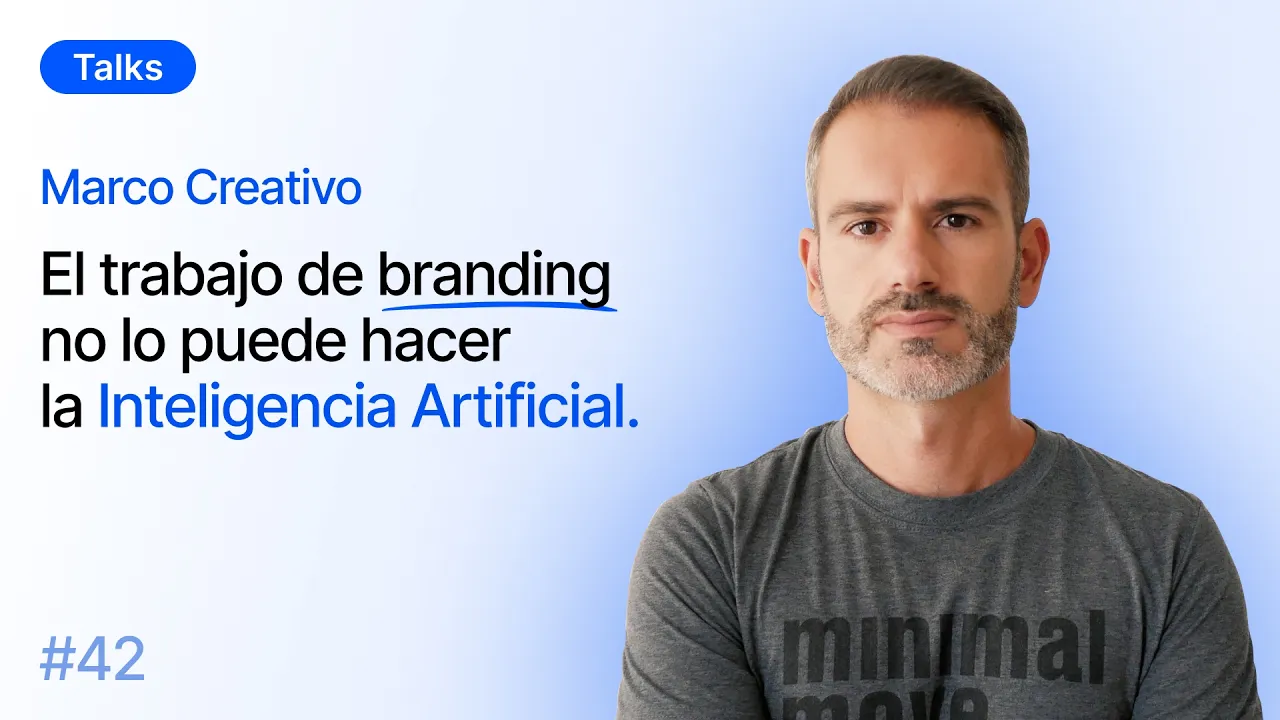
Marco shares how he transitioned from uploading YouTube content for his students to building a thriving design community, what his creative process looks like, and his perspective on brand building from a strategic, visual, and verbal standpoint. We also discuss the current standard of modern brands, the role of artificial intelligence in branding, and Escuela Fetén.
Marco Creativo: https://marcocreativo.es · Escuela Fetén: https://www.escuelafeten.es · YouTube, Instagram and TikTok: @marcocreativo
Full episode transcript
Introduction
Marco Creativo: Back then, anything related to computers meant… you were already an expert in design, in everything. They were looking for an IT specialist who knew how to design, and I discovered that design was what truly caught my attention—more than computing. I didn't dislike computing, but it lacked that creative and emotional spark that design genuinely has.
Marco Creativo: There comes a point when you decide to start a YouTube channel. I had already been teaching for four or five years. I had certain creative processes that I explained to my students, and I thought: “I’ll record a video for you, upload it online, and you'll have it there to watch whenever you like.” The subscriber count began to grow, numbers went up, and I completely lost control of it.
Marco Creativo: Look, right now we only take on one project at a time. I stopped focusing so much on the ‘wow’ factor and the element of surprise because the risk was quite high: the infamous “I like it or I don't like it”. It's about how the client assesses the work presented—from a more subjective angle or a more analytical one. Ultimately, all the decisions we make throughout the creative process are shaped and presented by us, but it's a collaboration. The client always feels (and rightly so) that they hold decision-making power.
Guille: How do you view the standard of corporate identity design from when you first started designing compared to now?
Marco Creativo: With AI, there are far too many visual fireworks. Everything is overly precious, excessively detailed, too pristine, too colourful. A brand might look gorgeous, but if it messes up whenever it speaks, it's utterly useless. I've always believed that if you want to connect with human beings, there has to be human work behind it; you can't delegate that task to a machine.
Marco Creativo: We took branding off its pedestal because we used to think it sat somewhere that required three university degrees to work in, and we've realised that isn't the case—because a brand cannot be replicated. No one can copy the perception people have of your brand; that perception simply cannot be duplicated. Brands require time to build. Those meanings won't stick in people's minds, firstly, if there is no iteration or direct experience with that brand, and secondly, if it isn't sustained over time. You cannot build a brand overnight: it takes years to consolidate.
Guille: Hi, Marco. Welcome to Brands 4 Future. How's it going? How are you?
Marco Creativo: Very well. How are things, Guillermo?
Early days in design
Guille: Very well, thanks. Delighted to have you on and to have a relaxed chat.
Marco Creativo: I love anything related to design and branding, so I'm thrilled to chat about whatever you like. I think these conversations are fantastic, especially to reflect, refresh ideas, and perhaps learn a thing or two along the way.
Guille: Indeed, that's what it's all about. Tell us about yourself: you've been creating content related to design and brands for years. How did you get into the design world? What was that first contact like?
Marco Creativo: Well, I fell into design somewhat by accident. I had always loved creating and designing. Initially, what I loved most was music—making a living from music—but obviously that was very difficult, so I chose to study Computer Engineering. In the end, I have the degree and the qualification in computing, although I've hardly ever practised it. Working with computers, I decided to venture into the design world too: FreeHand, Illustrator, QuarkXPress, Photoshop—everything available back then. I remember the [inaudible name] studio suite came on something like 30 or 40 floppy disks that you had to insert into the computer to install, but I played around with that a lot, loved creating things, and found that I really fancied that side of it. When I finished my degree, I joined a company that needed an IT specialist who could also handle a bit of design. I don't know if it's still like that today, but back then, anything to do with computers meant you were already an expert in design, in everything. That's where I started tinkering and discovered that design was what truly caught my attention—much more than computing. I didn't mind computing, but it lacked that creative, emotional touch that design has. So I decided to study design. At the time, I thought: “I really like this; let's see what courses are available nearby.” I decided to study everything within my reach, and from that moment on, I began dedicating myself exclusively to graphic design.
Guille: I take it these weren't online courses, given the era you're talking about, but rather graphic design schools, etc.
Marco Creativo: Yes, private schools or centres offering specialised training in design, print arts, and digital retouching. I also remember web programming, everything done with HTML and CSS. That sort of thing.
Guille: Of course. A lot of people have made that transition from traditional computing to design, but in a more self-taught way. In your case, you decided on something more formalised, since graphic design wasn't officially recognised as a university degree until very recently.
Marco Creativo: Until not long ago, yes. When I looked into it, there was nothing official in terms of a degree programme. There was the art school, but I couldn't afford to spend so many years there. So I decided to look for more streamlined courses—lasting 6 months or a year—that could give me that initial foundation I needed to start developing. Mind you, I've learned far more on the job day to day than from what they taught me in those courses, but they give you tools so that, at the very least, you start knowing how to manage.
Guille: Yes, because a lot of people come from illustration, or they take courses in various subjects (or used to; I think it's more structured now), or they come from Fine Arts, or go into graphic design, illustration, or advertising.
Marco Creativo: Yes, advertising appealed to me, but ultimately I'm more of a designer. Although I later decided to take a master's in advertising creativity—I spent a year studying it, and absolutely loved it too—I saw design as more feasible and achievable than advertising, especially in the area where we live. So I decided to pursue design, which is what has truly given me everything I have today. I encourage everyone: no matter what you study, if you later discover something else that fulfills you more and you'd like to try it, go for it, because any time is a good time to make a change.
Guille: Absolutely. And you're talking about an almost pre-digital era, or one where digital existed but very few professionals were dedicated to it, with far more emphasis on print and physical media.
Marco Creativo: Yes, everything revolved around print. Basically, there were advertising agencies and print houses; there were very few design studios. Everything was much more focused. Today, everything is far more diversified and there's a much broader offering, but it was an interesting era with its own quirks, and you learned a tremendous amount from the day-to-day work at a print shop. In the end, what we often miss nowadays—understanding how to send artwork to print—was fundamental back then.
Guille: Yes, I experienced the tail end of that as well, and sometimes I feel a bit nostalgic about that period: nowadays it's all screens and pixels, and I miss touching paper, the different paper stocks, seeing how work created on a screen is then printed and becomes physical. It has a romantic side to it.
Marco Creativo: Of course, that's wonderful. The smell of the paper, the ink, the texture: there's a sensory aspect to it that is truly lovely.
Guille: Perhaps now we're transitioning towards animation, towards motion design. Everything that used to be more about paper, tactile feel, knowledge of typefaces, and more technical aspects is now shifting towards branding in motion, sound, and other types of experiences rather than physical ones.
Marco Creativo: Yes, it has its merits too: interactivity, engagement, movement—things paper severely limited, naturally.
Guille: And from that period, you began training as a designer. Did you work at any studio? Today you run Marco Creativo studio; did you start directly as a freelancer, or as an agency?
Marco Creativo: I worked at a studio that practically did nothing but design business cards and prepare print sheets. I remember laying out sheets with dozens of business cards; it was a bit mad. I spent a few months there and then went straight into a marketing department at a construction firm, and later at another one. I don't know why, but there's a lot of construction in this region, and every opportunity that came my way was tied to that. I spent time in those two marketing departments, handling all the communications, design, and so forth. I learned a huge amount about print there too: we printed countless catalogues, floor plans, tons of materials that had to be designed, laid out, and prepared. I learned so much. I spent between 6 and 8 years as an employee, and then decided I wanted to at least try striking out on my own. It was a major step, but I had a friend who was already freelance, and for the first two months he invoiced on my behalf; after that, I registered as self-employed and took the leap. That was in 2008, so quite a few years have passed—nearly 20 years now.
Guille: And now you couldn't see yourself working anywhere else, could you?
Marco Creativo: Sometimes I miss it, because I originally set this up to have more people working alongside me. In fact, there was a period when I had people working with me; there were up to three of us, but then the pandemic hit, everyone went home, and in the end we all worked from our own homes individually. Naturally, I miss that personal interaction, seeing other people. If I were invited to work in a company with more people from time to time, I wouldn't mind. Full-time, I mean—because I have my studio, my YouTube channel, and my school, but sometimes I miss being around more people, being able to talk and share ideas. The same thing I do on YouTube—sitting down to record, explaining and discussing things I love—why not do that within a corporate department, assessing whether they're doing things right, what they could improve? Sometimes I think that could be quite nice.
Guille: Yes, bouncing ideas around: someone gives you an idea and you bounce it back.
Marco Creativo: Exactly. Yes, absolutely, I love that.
Guille: In design, I feel remote working makes you lose that: the feedback from the colleague sitting next to you, turning the screen around and asking, “What do you think of this?”.
Marco Creativo: Precisely. We do everything over video calls now. Right now, everyone working at the studio has plenty of video calls where we share screens and give feedback, but it's true that you miss out on that day-to-day immediacy.
Guille: Yes, same here, but ultimately the hesitation about “interrupting someone” is reduced in person. I'm of the view that we need to speak more—even if it's over video calls—calling each other often, and using chat as well.
Marco Creativo: Spot on. For us, WhatsApp is open all day, followed by video calls.
Starting the YouTube channel
Guille: Right. And there comes a point where you decide to launch a YouTube channel. Was that before or after setting up the studio?
Marco Creativo: Afterwards. You see, the YouTube channel came about because I had already been teaching for four or five years. I fell into teaching by chance: I was taking the master's in advertising creativity, and they noticed that all the graphic work I handed in was well crafted and saw that I had an aptitude for design. One day the school called me and said, “Why don't you pop in so we can chat?” They told me they had a graphic design course with 16 or 17 students and the course coordinator had left them in the lurch. They asked if I could take over a course that had already started—three months in—and teach the entire graphic design module. And I went: “Blimey, I've never taught in my life, I don't have all the necessary materials,” but I told them: “Well, let's give it a go.” I started; I remember downloading information from everywhere—syllabuses, exercises, countless resources—and tried to push the course forward, and in the end we managed to deliver a decent course. From then on, I began coordinating graphic design and advertising creativity courses, everything related to visual arts and advertising at that school, and eventually moved on to another school, and another over time. I had certain creative processes that I explained to my students, but they had questions and weren't going to spend all their time staring at notes, so I said: “I'll record a video for you, upload it online, and you'll have it there to watch whenever you want.” That's when I uploaded my first series of videos, “Creative process for designing a logo”: how I used to design logos when I started out. A very simple, basic creative process, but one that provides the tools to understand how to arrive at compelling graphic concepts for a logo. It went down really well. From there, my curiosity grew. I had a lot of material I taught my students, so I started recording short snippets on design, colour, typography, artwork prep, designing corporate stationery, various topics. I started recording those types of videos and the channel grew quite significantly. It's true that when I joined YouTube, I was perhaps fortunate that there wasn't much theoretical content in Spanish; in English there were a few fairly large channels discussing projects from a more theoretical standpoint—what to consider in the creative process and so on. It seems I hit the mark, people liked it, and it grew substantially up to the present day, but it was largely a stroke of luck.
Guille: Did the first videos you uploaded for your students gain views organically?
Marco Creativo: Not really. I remember at the beginning it was a hundred-odd views, nothing massive, but from there subscribers started to grow, views began climbing, and I lost track of it. I don't know exactly when it reached certain milestones because I don't follow analytics day-to-day, but within a few years I gained 100,000 or more; it was quite something.
Guille: I feel like I've seen you on YouTube forever: it seems as if Marco Creativo was already on the main feed the day the platform was launched. There was always a video on typography or any given topic.
Marco Creativo: Yes, perhaps because there were lots of tutorials on how to do this in Photoshop or Illustrator, but as far as I can recall, nobody—or virtually nobody—was talking about core design concepts. Many more emerged later, but when I jumped in, the field was wide open. I think YouTube really liked the content and thought: “Well, there's nothing in Spanish covering this,” and started recommending it, which gave me a massive boost.
Guille: And roughly what year are we talking about?
Marco Creativo: Around 2016, I think…
Marco Creativo: Which is when I started. I didn't start when the platform took off, which I believe was around 2012 or 2013.
Guille: I had the impression it was even earlier. [laughter] You could have told me 2008 and I would have believed you.
Marco Creativo: No, no. I think the first video I uploaded was in 2016.
Guille: And I gather from what you're saying that your intention wasn't to run a conventional YouTube channel, but rather to use it as a repository for your content.
Marco Creativo: Yes, to share with my students. For each of my classes, I had a Facebook group, because back then Facebook was still quite prominent; I had a group where I kept in touch with my students and shared the videos I uploaded to YouTube. However, I didn't set my YouTube channel to private: I made it public so anyone could watch. I shared bits and pieces and it kept growing, but at first I never thought “I'm going to do this for a living”, because I did it simply because I really felt like sharing things, and I've always enjoyed talking about my work and day-to-day routine. That's what I shared initially; it was well received, people liked it, and it took off. But honestly, I never could have imagined making a living off YouTube alone. Don't go thinking that having lots of subscribers means you earn enough to live on. It certainly gives you tremendous visibility, and the great benefit for me is that virtually 90% of the projects that come into the studio arrive through YouTube. So, rather than direct ad revenue, it's about the reach and the connections you build with people: the visibility and positioning it gives you.
Guille: From what year did you start taking it seriously as a substantial part of your work?
Marco Creativo: I think from the second year onwards it became a bit more intensive. I set myself the goal of releasing a video every two weeks, and no more than that because I simply couldn't: in my case, I handle everything myself and I don't have the editing skills other creators have, so it takes me a lot of effort. That part consumes a lot of time, so I settled on one video every fortnight. These days I release fewer, as I have less time. But I committed more seriously to discussing design topics. I had a vast amount of lecture notes, things that cropped up in class, exercises I set, small tutorials I delivered in class, and I decided to bring all of that over to YouTube. That was when I considered monetising a bit. In the beginning, you see €50, €60, €80, it creeps up little by little, €100, and you get excited: “I'm going to upload more and more.” But a moment arrives when you cannot stop pedalling, because if you stop, people forget about you a bit, and then it's harder to regain momentum. It's tough, it's demanding, it turns into a continuous and relentless task, and there comes a point where you feel quite overwhelmed.
Guille: You become a bit of a slave to it, don't you?
Marco Creativo: Yes, it's quite unforgiving, especially because, as I say, I don't make a living from YouTube; essentially, what YouTube pays me just covers my self-employment tax. But I have to keep up a certain consistency because, as I said, people forget about you and then climbing back up is much harder.
Guille: And regarding your audience: you clearly have a large subscriber base, but have you actively fostered community building—encouraging them to talk amongst themselves and nurturing a sense of belonging? Because I see a lot of engagement; it doesn't seem like one of those channels people just passively watch—there seems to be something deeper.
Marco Creativo: I've tried several times, but for some reason it never quite takes off. I set up a Discord… Being everywhere at once is impossible for me. I set up the channels, let people join and interact with one another, and then you see that many don't engage, others post spam, and I can't be everywhere moderating. My approach is: I publish videos, and if you want to comment, we chat there, but I don't maintain other platforms right now. I know there are lots of WhatsApp channels, WhatsApp groups, communities on Telegram, but that's just not me.
Guille: I know people send you content or their work for you to critique. And now you have the school (we can talk about that in a moment if you like), but even before that, I'm referring to that dynamic where they see you as an online tutor, or someone who lends a hand when needed.
Marco Creativo: I've always tried to reply to anyone who asked a question like “I don't know how to do this”. I'm the first to jump into the comments and reply, because I always like lending everyone a hand. It's true that I don't get as many emails now, but people still send me projects to review via social media—even more so now—and I can't review everyone's project because I don't have the time. What I do is curate a selection: I pick a few projects that I think have something interesting about them, where I can add value (because if everything is flawless, I'll just say “this project looks fantastic”, but I always try to find something to learn from), and then I feature that on YouTube. I can't review everyone's logos, because I don't gain anything from that and ultimately I need to dedicate time to my studio and my school, which is where I actually earn my living.
Guille: Of course. But that speaks volumes about the channel: people reaching out to say, “Could you review this? What do you think? What are the pros and cons?”, and so forth.
Marco Creativo: It's basically what I used to do in the classroom. In class, I reviewed all the students' projects, and I enjoy that because, in my experience, there is always room for improvement, backed by a professional perspective. No design decision is an absolute truth: everyone has their own perception, and some will resonate with what you say more than others, but there are always areas for refinement, especially technically, where I can contribute my two cents.
Guille: And explaining the ‘why’ behind things—that is super interesting. I've seen other channels that, when reviewing a project, don't focus as much on the rationale behind their decisions. I think that's essential, not just for designers who already understand the craft, but for business owners or design enthusiasts who don't work in the field. I think you always need to explain the rationale, in terms anyone can understand.
Marco Creativo: And I think that's also one of the hallmarks of this channel: I'm not overly technical, I don't have the ultra-academic background some designers have, and I use plainer, more down-to-earth language, which perhaps makes design accessible to everyone.
Marco Creativo Studio
Guille: Indeed. And beyond the YouTube channel, what about Marco Creativo as a studio: what kind of projects have you historically handled? What are you working on these days?
Marco Creativo: Right now, we only take on one project at a time. Typically, for the branding projects we undertake, we develop the strategic side first, followed by the visual and verbal elements, since our team is structured around that. We start a project and don't take on another until it's finished. Why? Because we understand that strategic processes require deep introspection and substantial information intake, and you can't divide your headspace across multiple projects. I tried that before and found it exceedingly difficult to juggle two tasks mentally, because strategy involves a great deal of data, emotional resonance, connection, uncovering the ‘why’, speaking extensively with the client, and unearthing elements that might not have been obvious at first glance. That requires immersing yourself completely in the project. We take on one project at a time and spend between three and four months on each; that's our current model. We work with brands globally. In fact, for practically the past two years, all our projects have come from outside Spain, driven entirely by the YouTube channel. Ultimately, when you show what you do and how you do it, people become interested; they want an external perspective. And what they value tremendously is our creative process, which is what we teach at the school: involving the client throughout the journey, guiding them hand-in-hand, asking questions, making them an active participant, encouraging them to interact, share their views, and evaluate. All the decisions we make in the creative process are articulated and presented, but it remains a collaboration. The client always feels (and it genuinely is the case) that they have decision-making power. They appreciate that immensely, they feel truly supported, and that's something we are very grateful for. That confidence is what led us to share this creative process at the school: having the certainty that we are doing it properly, and that clients not only leave satisfied, but understand the work, can implement it, and recognise the substantial, thoughtful process behind it.
The creative process
Guille: What specific action or way of working makes you say, “This is what sets us apart”? You talk about involving the client and so on; I completely agree with you: without the client taking part, sharing feedback, and being genuinely engaged, projects often lose much of their potential. So, what is your secret sauce—what do you think makes the biggest…?
Marco Creativo: In my case, I stopped focusing so much on the ‘wow’ factor and the surprise reveal because the risk was simply too high. When you start out with projects that aren't particularly expensive, you can perhaps afford to take that gamble. But once you're dealing with projects over £10,000 or £20,000, the stakes are high, and I prefer taking measured steps. So, at every key decision-making milestone in the creative process, the client must be involved: either you walk them through the solution you've reached so they understand it, or you present several options and evaluate, vote, and decide which direction is the winner and most suitable for that project at that time. At every key milestone where an important step forward is taken, the client participates. I believe continuous validation is the key. Validation at specific junctures. For instance, this is how we handle the strategic platform: first, we do a territory phase where three territories are presented. The client chooses, and from there, we define the platform. The platform is defined in full once we have settled on the territory, and then presented to the client. The client can always add notes and nuances—whether they agree or disagree; there are always minor adjustments, which is never an issue. But some parts we tackle in one go because once you get stuck into developing the platform (anyone who has developed strategic platforms knows this), everything is interconnected: you start at one point and finish at another, step by step. Consequently, you can't pause halfway through to do a presentation; until the platform is fully fleshed out, you can't present it. By contrast, on the visual side, I used to handle the entire process internally and present two or three visual identities. That meant a huge amount of work for me, carrying the risk that either the surprise would be massive and positive, or the client might suddenly want to mix and match elements, or what you thought would resonate with them completely falls flat. Those errors or issues can be serious if you reach that stage. So what we do is take it step by step. First, we explore the category: what exists in the category? We analyse and draw objective conclusions about what is being done in terms of colour, logos, composition, form, and symbolism—everything. I'm focusing on the visual side, but this applies to territories as well: what is everyone doing in their space?
Guille: Yes, in strategy you examine the territory aspect: trying to infer which territory each competitor occupies.
Marco Creativo: Exactly. But on the visual side, which I think designers grasp most readily, I prefer moving step by step: first we analyse the category, then I propose different potential visual styles and put the client to the test. I present a style and ask them questions about it. The client might say: “Ah, look, this is great, this isn't, this fits us better, this feels too formal, that's not who we are.”
Guille: Something like a moodboard of references?
Marco Creativo: Exactly. Yes, but focused on styles. I work by styles. I used to present a moodboard with countless styles: a typeface here, a colour swatch there… The moodboard looked gorgeous, but it was practically useless.
Guille: Meaning, with defined, concrete creative directions.
Marco Creativo: Yes. I focus heavily on projects that have already been executed, launched, and validated in some way. I pull that information together and present the client with a specific style, a concrete path from an existing project.
Guille: And not random image references, like photography samples, but always from established brand identities and developed projects.
Marco Creativo: Precisely. We present directions that have already been developed and ask about aspects we find interesting: for example, the use of colour in this project, the typographic treatment, how this brand communicates, the style of headlines they use, or how the logo is applied here. In other words, I ask questions that prompt the client to evaluate each project and determine: “Personally, this doesn't feel right for us.” Ultimately, it's about alignment: you cannot impose a style or solution on a client. The client has to feel aligned with what you're showing them. Through a series of questions, I gauge that fit, and finally (anyone who has taken the Fetén courses will know this), we score them: we want the client to actively evaluate. So we say: “Let's score this; what mark would you give this project?” And we assess it. In the end, we simply identify fits: we see that the client aligns more with one style and direction than another. What we do then is synthesise: we take the elements that fit best from each project, create a synthesis, and develop from there. We move step by step, always alongside the client and with their validation at every decision. When the final presentation arrives, there's naturally still a ‘wow’ factor, so to speak—because seeing a standalone logo and colour palette isn't the same as seeing them applied across mockups and motion—but everything is far more controlled, and the client already knows what to expect. And the very same approach I mentioned for routes and styles is applied to the logo. I used to dive straight into logo design and present several complete options. Not anymore: now I run a test, a beta proof, presenting three options—either symbols or wordmarks—alongside colour palettes, typographic choices, and tone of voice. I explain the reasoning behind each solution and what factors influenced every choice, and from there, they evaluate the fit. Many clients are crystal clear from the start: you present it and they say, “Wow, I can't stop thinking about that one solution, that's the one,” so we run with it. Others say: “I need to reflect on this and run it by the team.” But usually, the client selects from those proposals, and once they've chosen, you build out everything else: typography, colour system, palette refinement, pairings, and so on. Until they have validated that initial decision-making phase, I don't proceed to the next stage. That's how we move forward gradually, and I think it makes total sense, because at the end of the day, you don't want your work discarded or to spend more hours on a project than you should.
Guille: Indeed. Taking too many steps forward only to run the risk of having to backtrack.
Marco Creativo: Exactly. If I had to name the key takeaway: share those crucial milestones with the client and ensure they take part in those decisions.
Guille: Yes, it makes complete sense. We follow similar practices, though perhaps not with quite as many milestones. [laughter] You've given me food for thought.
Marco Creativo: It's much easier for us; it covers our backs.
Guille: I was going to ask you about client feedback—the classic “I like it or I don't like it”, which comes down to whether the client can critique the work presented from a subjective viewpoint or an analytical one. It can be challenging, and you often have to educate them, but people often say that in Anglo-Saxon or Central European countries, looking at work analytically is much more normalised, whereas in Spain we still get “I just don't like it”, or “my wife said this”, or “my cousin thinks that”. I don't know if that's a myth, if we sell ourselves short in Spain, or if it's true.
Marco Creativo: Look, that can happen anywhere, because those of us working in visual design always bring hints of personal taste, individual experiences, and things we have or haven't seen. I think that always plays a part. But in our case, as I said, visual design is virtually the final stage of the process. Because we've already laid so much groundwork, reasoned everything out, and grounded what we're building, the client is very hesitant to simply say “I like it or I don't like it”. When they offer feedback, they almost always try to back it up with sound arguments. As I mentioned, that used to happen to me when I presented two or three complete visual routes: if the client hadn't seen anything beforehand, it was either “I love it” or “I hate it”. But when you take it step by step, the client already anticipates what's coming and has a good idea of the overarching universe. Something might still need refining or tweaking—perhaps we realise a gradient doesn't reproduce well or lacks contrast, or a typeface isn't fully legible, whatever it may be. But the client is already primed so that if they have feedback, it must be supported by a solid rationale.
Guille: So you ensure it follows logically, right? The final design is anticipated. You sacrifice a bit of the surprise factor, as you mentioned, but you gain that undeniable logic: everything fits within a reasoned framework.
Marco Creativo: Exactly. You gain the confidence and peace of mind that the client won't throw their hands up in horror, and if adjustments are needed, they will be much simpler, more logical, and well-managed; there won't be massive overhauls. Today, I much prefer it this way. When I was younger, I was perhaps a bit bolder and took bigger risks, but nowadays I prefer covering all bases. It's better for the client—they leave much happier—and better for you, as it streamlines time and boosts profitability.
The standard of modern brands
Guille: And across the industry in general, how do you see identity design and the overall standard of companies, both corporate giants and SMEs? How have you seen it evolve in recent years, from when you started out until now? Has brand quality improved strategically, and visually—which is often all the public sees? Do you think the bar has been raised, or is it true, as some say, that design has become homogenised, whereas it used to be more diverse and versatile?
Marco Creativo: In my view, and from what I've observed (especially when we audit client categories, where we analyse what competitors are doing visually and strategically), we notice there's still a long way to go, both visually and strategically. Strategy, let me tell all the designers listening, is something you should start offering immediately, because demand for it is going to explode. Hardly anyone is tackling strategy properly, and every client who comes to us no longer asks solely for visuals: they demand a strategic foundation because they need clarity on what they are doing. Strategically speaking, the field is practically barren; there's hardly anything. And visually, there are too many clichés and far too much of the same old thing. Perhaps we need a moment to take a breather. I feel that visually we ought to dial back the intensity, especially now that AI is producing so many visual fireworks: everything is overly precious, intricately detailed, flawless, and ultra-saturated. I believe we need to tone down the visual intensity and dial up the strategic and verbal components—the messaging—because a brand can look stunning, but if it falls flat whenever it communicates, it's completely useless.
Guille: Indeed.
Marco Creativo: My sense is that we are at a point where we need to lower the intensity of the visual side—make things a bit more neutral, more understated, less saccharine—and ramp up the strategic and verbal aspects. That's where brands are genuinely standing out, because logos are going to look very similar: they will all be decent logos, technically sound. A colour palette is ultimately just a strategic asset you can lean on to varying degrees; on social media, palettes get diluted because everything shared consists of photos and videos, so it only carries you so far. Therefore, I think we need to ease off the visual throttle and focus more on communications, verbal identity, and strategy. That's my general impression, but as I say, whenever we audit categories, we realise there's a lot of work to be done—especially on the strategy side, which is where almost everyone falls short.
Guille: Of course. And I take it you don't start a project without first establishing that strategic foundation.
Marco Creativo: That's right.
Guille: Because, for example, one of the issues we discussed—the “I like it or I don't like it” response—often stems from tackling identity directly without addressing strategy first, even when clients insist: “I'm totally clear on my brand territory, positioning, values…”. In the end, skipping that just invites subjectivity, doesn't it?
Marco Creativo: Yes. And remember, what the client thinks they want or have is one thing; auditing the category to uncover what strategic position truly serves us best is another. Because ultimately, every move in brand building is strategic. You must be crystal clear on what you want to project to stay relevant and have something meaningful to say to your audience, so you don't just blend in as another pretty, flashy package that catches the eye for a week and then fades into the background. I think you need to be very clear about what you want to project as a brand, what legacy you want to leave behind, and what the audience takes away from that touchpoint, from that experience. We can technically craft a visual identity without strategy—we've done it in the past—but it's a suit where you don't know how long it will last, whether it will work, or if it will flop. It will probably look visually appealing, but so do hundreds of thousands of others, meaning it doesn't solve any business needs. As I see it today, the most crucial element in branding is that connection with the user, that experience: what are you going to say to them? How are you going to say it? That is far more important than having a great logo. And I'm a logo designer—I adore designing logos—but that user experience, what you offer them, and the stance you speak from matter vastly more than all the decoration and colours around it. Having that visual aesthetic emerge as a direct result of strategy is essential; if it isn't, you have no certainty whether you've nailed it or not—you're just shooting in the dark.
Artificial Intelligence in branding
Guille: You mentioned artificial intelligence, which has been the elephant in the room over the last few years.
Marco Creativo: Yes.
Guille: Looking back at the creative sphere, I remember claims like “artificial intelligence will be great at processes, but it will never touch creativity”. Then suddenly it starts producing work (whether you call it creativity or not), and then the question arises: “Aren't we humans also beings who draw on inspiration and references?”. Even before artificial intelligence, design was already homogenising, particularly in UI: every interface follows very similar patterns. I think back to 90s websites, which were much more innovative, much more creative in the true sense of the word. And now with AI, I do see homogenisation, but I also see positives. I'd love to hear your take: how are you using it in the studio, if at all, and how do you see others using it? You've already touched upon the visual fireworks.
Marco Creativo: Look, it's like anything: it remains a tool that will keep improving, and what seems questionable or rather arbitrary today might make far more sense tomorrow and manage to evoke genuine emotion. But branding is truly a series of touchpoints: there are countless elements behind it, and you have to navigate them from a much more human, emotional standpoint, understanding how to connect with people. If you want to leave that part of your business to a machine, you can, but I firmly believe that if you want to connect with humans, there must be human work behind it; you cannot outsource that task to a machine. For the technical side or pure execution, you can certainly leverage AI to generate a piece of copy or a graphic element; for very specific tasks, it can be useful. Right now, we take a very artisanal approach: we like doing everything ourselves, though we might ask AI for assistance if we hit a wall where it can genuinely help. For now, take logos, for example: the other day I was working on logo concepts and spent an entire afternoon on it. You could ask an AI and it might spit out dozens of ideas, sure, but as a designer, I need to test things myself to understand what's required. I think I'll work much faster and find it far more rewarding than constantly prompting an AI until it generates something that vaguely fits. For me, manual work is still far more satisfying. Our processes are craft-based; that's why we start and finish sequentially. My business model isn't scalable precisely because there are only three or four of us, and we handle projects from start to finish. If we ever need AI support to generate a mockup, an application, or whatever, we'll use it. But currently, our process is entirely hands-on.
Guille: And what about competitor analysis—using it to gather information, research, and documentation—do you use it for that?
Marco Creativo: We have a team member who reads through the latest posts, scours the website, reads interviews, looks up references and reviews; they comb through all the information. We don't have an AI doing that because, as I said, to develop a branding process you have to immerse yourself completely—you have to get right under the bonnet of the project—and for that, reading it yourself, reviewing it, and engaging in that exercise is essential. If we hand that over to an AI and it gives us a summary or an output, I'm not sure that helps us truly grasp the essence and connect with the business. You need deeper insights. Furthermore, when conducting a strategic audit of a category, you have to read between the lines: brands don't explicitly say “these are our personality traits, this is our territory”; you have to deduce it yourself, extract it. I believe that interpretation and perception are best handled by a human, because AI will give you its own interpretation, and if you blindly trust AI, that's on you. But for now, we believe branding has a profoundly important human element, because brands connect directly with people. If a machine builds your brand, I don't think you're doing good work: you won't be able to unlock the emotional triggers that truly resonate with people. As I see it, humans must always be behind that kind of analysis.
Guille: Absolutely. I wholeheartedly agree with what you're saying. For instance, visually speaking, one of the most useful applications I see is that instead of hunting for stock images on sites like Unsplash, you can now generate the exact image you were looking for, or create bespoke backgrounds and gradients, achieving very specific photographic styles or tweaking an existing image's style swiftly without setting up a photoshoot. For product photography, it's incredible. But I completely share your sentiment, and I believe craftsmanship—the non-mass-produced—will become a major differentiator in the future. My only question is whether clients will appreciate that added value, because obviously… I'm not sure if there's an AI right now capable of producing an entire visual identity from scratch, for example.
Marco Creativo: There is.
Guille: Even so, once it becomes mainstream, many clients will think: “Well, I can just do this myself.”
Marco Creativo: Well, it probably exists, and if not, it will soon. Whether the logo actually works in positive and negative, in vector format, scaled up or down—that will still require a professional, as always. But clients doing it themselves… I think there will be a bit of everything, as with anything in life. When Canva came along, people panicked, but what Canva actually achieved on a positive note is that people started valuing design more: they had no design before, now they have design, and they've realised that good design yields better results. It elevated the perception of design. If they want something proper and don't have the time—because at the end of the day, you have a business to run—they'll have to hire a professional. It's like having a plumbing problem at home: if you have the time and you're handy, you'll fix it yourself; if not, you'll hire a plumber. There will always be both types of clients.
Guille: Of course.
Marco Creativo: Those who value human processes and the craft of an expert—knowing that with a professional, the outcome will be solid because that person lives and breathes it—will appreciate it and be willing to pay for it.
Guille: Having artificial intelligence or Canva at your fingertips doesn't give you discernment, which is precisely what's needed. It's like the old anecdote: “You charged me all this money just to turn a screw?”, and the reply: “No, I charged you for knowing which screw to turn.”
Marco Creativo: Exactly. In branding, the key is knowing which screw to turn: knowing which colour you need, which style suits you, how that element integrates into your messaging, what you stand for, how you express yourself, and ensuring all of that aligns to achieve specific goals, whether that's a vision or a purpose. You need defined brand objectives. All of that is developed collectively: first, to foster an internal culture within the organisation so that everyone aligns with those values, principles, and shared purpose; and second, so that external audiences and clients can connect with you and those ideals. There has to be a foundation of human effort; using AI to assist you is fine, but if you want the confidence that what you're doing is right, you need a creative, strategic branding process—otherwise, you're flying blind.
Escuela Fetén
Guille: Well, to wrap up, I'd like to ask you about the school you founded relatively recently, or at least that I discovered recently. How long has it been running? Under a year, right?
Marco Creativo: A year. Exactly a year this month. Well, we hit one year in April. We're running a promotion right now. Escuela Fetén.
Guille: Escuela Fetén.
Marco Creativo: I always knew I wanted to launch an educational project; it was crystal clear to me. The challenge was that I first needed a team to establish a proven creative process—one that gave me the confidence that what I was teaching would truly benefit people, that it was a tried-and-tested method with key insights we'd integrated over time and deemed essential when working with clients. What we did was bring that down to earth: translating it into actionable, shareable knowledge. It took time; we spent over two years preparing materials and content. Then, of course, filming and editing it (I handle it all myself, an absolute madhouse, as you can imagine), but it had to be done. We decided to demystify that creative process and explain it in an approachable way. Fetén stands out mainly because we use very relatable language; we're a bit cheeky, we love humour, we include tons of real studio case studies, share behind-the-scenes anecdotes, and give away our exact working templates for students to use—we hold nothing back. What we love about Fetén is, first, taking branding off its pedestal, because people treated it as though you needed three degrees to work in it, and we've shown that isn't true: you just need a well-explained process, applicable tools, and clear comprehension. That's what we set out to do: make it practical. We've built modules for each stage of our creative process. We have three modules so far. One covers discovery and diagnosis: the whole audit and client briefing phase. Another covers the strategic platform: defining the platform through brand territory and its core components. And we've just launched verbal identity: brand communications, tone of voice, narrative, storytelling, the brand manifesto, taglines, and even naming—how to create brand names. We packed all of that into this latest module, which is a massive unit. All that remains is the final phase: visual identity, which everyone is waiting for us to release, but for me, it's the part that needs to be absolutely spot on. Firstly, because I'm a graphic designer and hold this to high standards, and secondly, because it has to be grounded in reality. It's less theoretical, although Fetén isn't a school to teach you how to design: it's a school that teaches you how to think, how brands function, how they express themselves, evolve, and communicate, how to collaborate with clients, and what to communicate to them. Fetén is designed to elevate you professionally so you can say: “Right, I've been a graphic designer all my life, just executing briefs and taking orders, and now I want to move into strategic thinking.” Fetén guides you across that bridge. It's built for people who already design; it isn't a beginner's course.
Guille: Right. Or even for people who don't design.
Marco Creativo: Yes. Imagine you want to get into brand building and you aren't a designer: you can still study at Fetén, because it teaches you how to run audits and craft a strategic platform, which doesn't require design skills. But it isn't an intro to design, if you catch my drift. You could take it without prior design knowledge, yes, because we explain our creative process from A to Z. If you want to design, you need that graphic design foundation. We teach you the strategic process, enabling you to offer services you couldn't before: we have students who used to be pure designers and now offer brand audits, which they never did previously, or students who now deliver strategic platforms. And a strategic platform, much like an audit, doesn't require graphic design expertise: it simply demands logic, common sense, and the methodology to apply it. That's it. Nothing more.
Guille: And roughly how long are the courses?
Marco Creativo: They are pre-recorded videos: all the lessons are recorded, you purchase them and study at your own pace. All courses have a set access window: for our entry price, you get access for a limited time. The first course, which is the shortest, has 15 or 20 lessons, running for about an hour and a half in total. When you buy it, you get access for three months, I believe. You can easily finish it in a week; obviously, some people invest more time and others take it slower. As the courses expand—take the strategic platform, for example—we're talking about over 4 hours of content, and verbal identity runs over 6 hours, so we grant considerably more time for those. You can also purchase lifetime access. We debated: should we offer lifetime access or time-limited access? But what happens to all of us when we buy a course with lifetime access? We never actually do it.
Guille: Spot on.
Marco Creativo: You leave it sitting there, do one lesson today, say “I'll get back to it later”, and never finish it. We wanted people to actually complete it, which is why we set a tighter timeframe. It's working brilliantly so far. Some people buy the limited-access version and later say, “Crikey, I want this permanently,” and upgrade to lifetime access. But these courses are designed to teach you how to think, challenge assumptions, and grasp how a brand works. That's the beauty of it: we felt there was a gap in the market. Other branding schools existed, but perhaps lacked the approachable, down-to-earth vibe of a boutique studio like ours—we aren't a corporate consultancy—and we felt we could deliver this training from a more relaxed, engaging, and enjoyable angle, without being so rigid.
Guille: I like what you said about stripping away the elitism around branding, you know?
Marco Creativo: Yes, I think that's a hangover from when branding was reserved solely for blue-chip companies, but there has been a democratisation: every brand should develop its strategic and visual identity. However modest their efforts, they should at least address the fundamentals.
Guille: To wrap up, is there any content you'd like to recommend—a book, a documentary, anything you think could help those interested in design and branding…?
Marco Creativo: Well, I'm not one to recommend books constantly. I buy the odd book now and then, and sure, we recommend a few, but above all I'd tell people to start questioning how brands are actually built, as that is the foundation of everything. There are plenty of books by Wolff Olins… I really like Simon Sinek's book, “Start with Why”, which mirrors our own brand development process: starting with the why, the how, and the what. Ultimately, that gives you the fundamental tools to understand how to guide a brand forward and bring it to life. You have to realise that any company relies on two pillars. The business pillar, which encompasses all partners, suppliers, pricing, costs, logistics, operations, innovation, research, and so on. And the brand pillar, which is how we project that outward to our customers—what we tell them, the position we occupy, our value proposition: that is the brand side. Those two pillars must be balanced. You can have an incredible product, but if you don't build the brand, the product can be replicated and copied by a competitor, cutting the ground from under your feet. That's why businesses realise that the greatest asset today is brand building, because a brand cannot be replicated. Nobody can copy the perception people have of your brand. That perception cannot be duplicated; you can copy a logo, you can copy a colour palette, but the perception of a brand name and an entity cannot be copied. It's the personality it exudes. The associations that come to mind when you hear Nike, Apple, Nintendo, or any brand rich with meaning—those associations cannot be copied; they are innate to that brand. That is what must be nurtured over time, and these are long-term relationships.
Guille: You mentioned Nintendo, and I'm sure many people have childhood memories tied to Nintendo. Those are relationships spanning 30 or 40 years.
Marco Creativo: Brands require time to build. Those meanings won't stick in people's minds, firstly, if there is no iteration or direct experience with that brand, and secondly, if it isn't sustained over time. You cannot build a brand overnight: it takes years to consolidate. But you need to know what to consolidate and how, and that's what branding provides: it gives you the tools to identify those meanings and know what to start building. I would encourage people to study everything they can about branding and read extensively on strategic brand building. You don't need to be a designer, nor have a background in design, communications, or advertising: ultimately it's common sense, curiosity, a desire to learn, and having a workable methodology. With that alone, I can assure you that you can enter the branding world, provided you're clear on what's required.
Guille: Fantastic. We'll leave links in the video description so viewers can find your website, Instagram, and YouTube; I'm sure many people already know you, and Fetén as well. Let me know if there's anything specific you'd like us to include, but social channels, the website, and so on will be there.
Marco Creativo: Yes, all of them. In the end, Marco Creativo: I mainly use Instagram and YouTube, alongside Escuela Fetén, which also has an Instagram and a website. People can easily track me down. We're active there, especially on Instagram, which is the platform I use most and keep most active. And naturally, for content, videos, and insights, there's YouTube, where I discuss brands, break down case studies, and occasionally touch on controversies; a bit of everything related to the branding universe. You'll find me there, with everything you need.
Guille: And there's a wealth of content to learn from, as you mentioned. Through your YouTube channel or Instagram alone, people can learn a great deal about global brands—like the recent Amazonas rebrand, or Mapfre, to name a couple of recent examples. You feature plenty of major case studies.
Marco Creativo: I analyse them primarily through the lens of a designer and branding professional who understands how brands communicate. From that vantage point, I try to unpack the reasoning behind each change and assess what works well or misses the mark, based on my professional judgment.
Guille: Yes, from an outside perspective.
Marco Creativo: From the outside, yes, but people appreciate it—mostly because, as I say, we haven't spoken enough in language ordinary people understand. We've leaned too heavily into technical jargon, and often (I noticed this when I started out), people threw around overly technical terms and clients hadn't the foggiest idea what we were talking about. We need to shift that mindset and start using approachable language that resonates, because the best relationships are built when the client understands what you're doing for them and why. That's fundamental. If they understand that, consider your job well done, because you're succeeding.
Guille: Hats off to that. I've thoroughly enjoyed our chat, Marco. Thank you so much for joining us; you're always welcome here, and if an intriguing case study or debate comes up down the line, I'll definitely invite you back onto the podcast.
Marco Creativo: Brilliant, Guillermo. Truly, thank you as well for having me on Brands 4 Future, which I urge everyone to watch; I take it it's on YouTube too.
Guille: Yes, on video, and on Spotify…
Marco Creativo: And anywhere else? Etc.
Guille: Yes, across all platforms: Spotify, Apple Podcasts, all of them.
Marco Creativo: Fantastic. Be sure to share it far and wide. Let's all tune in to this podcast. Best of luck, Guillermo; have a wonderful day over there, and let's definitely keep in touch. Take care, all the best. See you soon.
‹ Ritxi Ostáriz - The symbol, universal stories, Jung, the hero's journey | B4F #40
Raúl Marín - Digital product without the hype | B4F #43 ›


